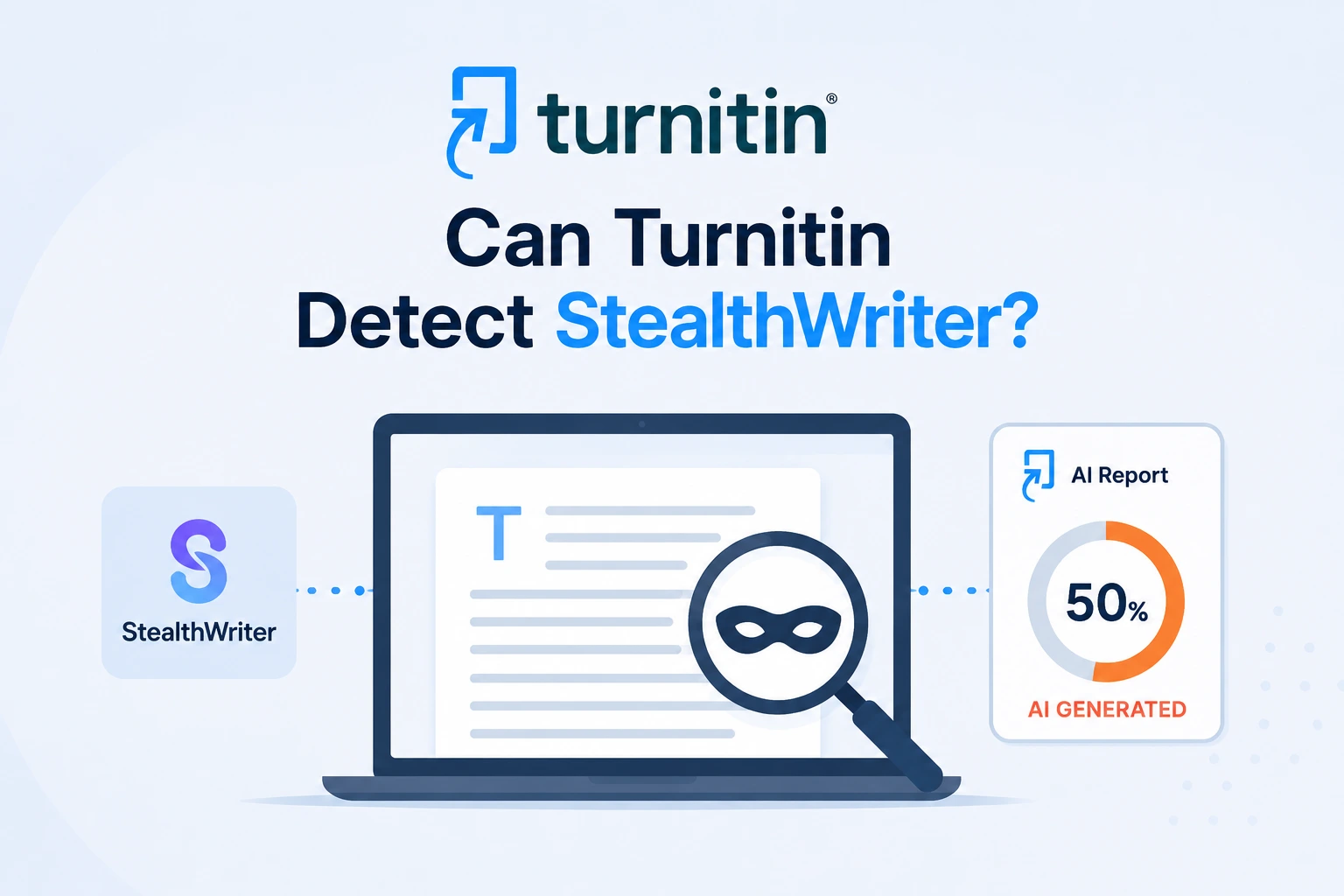
StealthWriter markets itself as a tool that rewrites AI-generated content into natural, human-like writing that bypasses AI detectors — including Turnitin. Students have been using it and similar tools ever since Turnitin launched its AI writing detection feature, hoping to submit AI-assisted work without triggering a flag.
The question is whether it actually works. The honest answer is more complicated than StealthWriter’s marketing suggests.
What Is StealthWriter?
StealthWriter is an AI humanizer — a tool that takes text generated by AI models such as ChatGPT, Claude, or Gemini and rewrites it to reduce the statistical patterns that AI detectors look for. It offers multiple rewrite intensities (light, medium, and aggressive), a built-in AI detector to check results before submission, and claims to produce clean, grammatically correct output in seconds.
It is one of dozens of tools in this category. Others include QuillBot, Undetectable.ai, StealthGPT, and Humanizer Pro. All of them operate on a broadly similar premise: AI-generated text has detectable statistical fingerprints — predictable word choices, uniform sentence structures, consistent rhythm — and humanizer tools attempt to break those patterns by rewriting the text to introduce more variation.
StealthWriter’s own FAQ states plainly that the tool is “continuously updated to ensure your humanized content stays natural and high-quality as writing standards evolve.”
What it does not say clearly is that Turnitin is also continuously updated — and has been specifically updated to catch exactly what StealthWriter does.
How Turnitin Detects AI-Humanized Text
To understand whether StealthWriter can evade Turnitin, it helps to understand what Turnitin is now looking for.
When Turnitin first launched AI detection, its original model (AIW-1) was trained to detect text generated directly by large language models. Students quickly discovered that running AI output through paraphrasing tools could reduce or eliminate the detection score. For a period, humanizer tools worked reasonably well against Turnitin’s original model.
Turnitin responded. According to Turnitin’s official AI writing detection FAQ, the system has since evolved significantly:
- AIR-1 — AI rephrasing detection: A dedicated model trained specifically on text that had been processed through AI paraphrasing and humanizing tools. This model was built to catch exactly the output that QuillBot, StealthWriter, and similar tools produce.
- AI bypasser detection: Turnitin subsequently added detection for what it calls “AI bypasser tools” — tools designed specifically to evade AI detection. This layer sits as a sub-category within the AI-generated text highlight, meaning Turnitin can now distinguish between raw AI text, AI-paraphrased text, and AI text that was run through a bypasser.
The AI Writing Report now displays two distinct highlight categories:
- Cyan highlights: Text likely generated directly by an AI model, including text that may have been modified by a bypasser tool
- Purple highlights: Text likely generated by AI and then revised using an AI paraphrasing tool such as QuillBot
According to Turnitin’s official model guide, these categories provide “more granularity into what AI capabilities were used and where.”
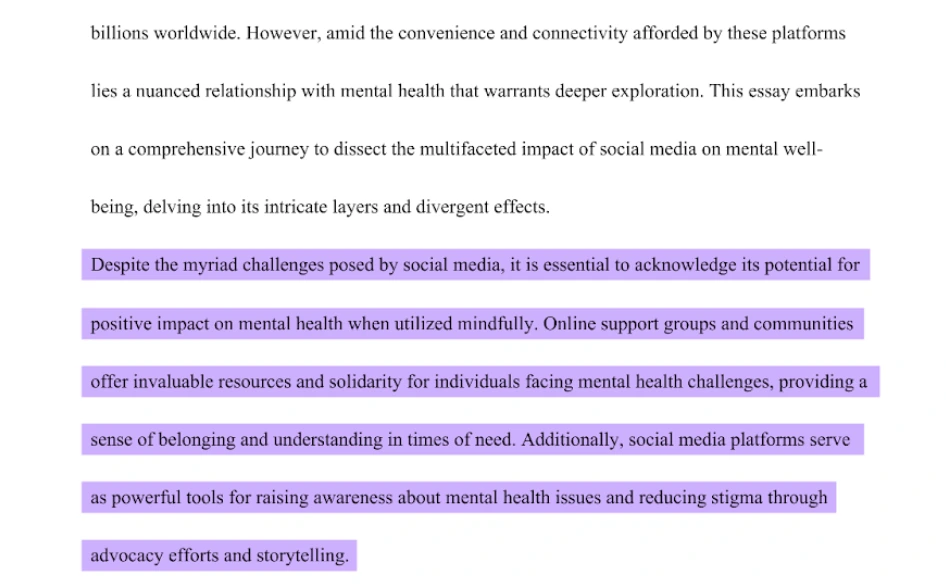
StealthWriter, by definition, falls into the category of tools Turnitin has specifically trained its models to detect.
What StealthWriter Claims — and What Testing Shows
StealthWriter’s website claims its tool produces text that bypasses major AI detectors including Turnitin. Its built-in detector shows scores “before and after” humanization to let users verify results themselves.
However, the built-in detector StealthWriter uses to verify its own output is not Turnitin. It uses its own detection models — and third-party AI detectors like GPTZero or Originality.ai — as proxies. Passing those detectors does not mean the output will pass Turnitin, which uses a different, proprietary model trained on its own datasets and updated independently of every other detector on the market.
Independent reviewers who have tested StealthWriter against Turnitin report inconsistent results. At its “light” rewrite setting, StealthWriter produces relatively minor changes to the original AI text — enough to fool basic detectors but unlikely to break the statistical patterns Turnitin’s AIR-1 model is specifically trained to identify. At “aggressive” settings, the rewriting is more substantial, but the output can become noticeably unnatural in places — which creates a different kind of problem.
The deeper issue is structural: StealthWriter rewrites word choice, sentence rhythm, and phrasing. What it cannot easily change is the underlying argument structure, paragraph logic, and content organization that AI models tend to produce. Turnitin’s detection does not rely solely on surface-level word statistics — it evaluates writing at the segment level, analyzing overlapping windows of approximately 250 words. A surface-level rewrite may alter the words while leaving the deeper statistical profile largely intact.
The Arms Race Problem
There is a fundamental dynamic at play here that students using any AI humanizer should understand: this is an ongoing arms race, and Turnitin has significantly more resources than any humanizer company.
Turnitin has processed hundreds of millions of papers through its AI detector. That volume of real-world data is used to continuously retrain and improve its models. Every time a humanizer tool releases a new rewriting approach, Turnitin’s dataset of detected papers grows to include examples of that approach — making future detection more accurate against that specific tool.
StealthWriter’s own FAQ acknowledges this indirectly, stating the tool is “continuously updated” as detection standards evolve. But the update cycle of a small AI humanizer company cannot realistically match the update cycle of a company with Turnitin’s scale, institutional partnerships, and detection research capacity.
Turnitin’s AIR-1 model was trained specifically on output from popular humanizer tools. Bypasser detection followed — meaning Turnitin now has a dedicated detection layer for the category of tool StealthWriter belongs to. Students relying on StealthWriter to stay ahead of Turnitin are betting on a tool that Turnitin has explicitly trained its models to identify.
For a full picture of how Turnitin’s AI detection model works and what it is currently trained to catch, see the post on how Turnitin scores are calculated.
What About the Similarity Score?
A question some students have is whether StealthWriter affects the similarity score as well as the AI detection score. The two are independent — the similarity score measures overlap with existing content in Turnitin’s database, while the AI detection score measures writing pattern characteristics.
StealthWriter rewrites AI-generated text rather than copying it from an existing source, so it does not typically increase the similarity score in the way that direct copying would. In fact, because the rewritten text does not match any specific source, it may produce a low similarity score — while still producing a high AI detection score.
This matters because a student who checks their similarity score after running text through StealthWriter and sees a low percentage may incorrectly assume they are safe. The AI detection score is entirely separate and invisible to students — only instructors and administrators see it. A green similarity score with a high AI detection flag behind it is a combination that catches many students off guard.
See the post on whether Turnitin’s AI detector is always accurate for important context on how instructors are expected to interpret AI scores — and why the score is never the end of the story.
The Academic Integrity Risk
Beyond detection, there is a practical risk worth naming clearly. Submitting AI-generated text — even humanized AI text — as your own work without disclosure is a violation of academic integrity policies at most institutions. The specific policies vary by university and by assignment, but the core principle is consistent: the work submitted must represent the student’s own thinking, research, and writing.
If a student is caught submitting humanized AI text, the fact that it was processed through StealthWriter does not change the nature of the submission. It may, in fact, make the case for misconduct stronger — because using a tool specifically designed to evade academic integrity detection demonstrates awareness of the rule being broken.
Turnitin’s own documentation makes clear that the AI report is designed to “open a conversation” between instructor and student — not to function as an automatic verdict. Instructors who see a flagged submission will ask questions. A student who cannot speak to the development of their paper, provide draft history, or explain their sources is in a very difficult position regardless of what the AI score says.
For the broader context on AI-generated content and what it can cost a student, see the post on why AI-generated assignments could cost you your degree.
Conclusion
StealthWriter is a capable AI humanizer that can reduce detection scores on many general-purpose AI detectors. Against Turnitin specifically, the picture is different. Turnitin has been explicitly updated to detect AI-paraphrased text and AI bypasser tools — the exact category of tool that StealthWriter is.
Whether StealthWriter succeeds in any individual case depends on the rewrite intensity used, the specific text involved, the version of Turnitin’s model active at the time of submission, and how the instructor interprets the resulting report. There is no guarantee of consistent evasion, and the tools Turnitin now uses have been built specifically for this scenario.
Students looking to understand exactly what their Turnitin report will show before submitting are better served by getting a legitimate preview of their report and checking it themselves. See the Turnitin AI detection report example for a clear walkthrough of what instructors see — including the cyan and purple highlights that indicate AI-generated and AI-paraphrased text.
Frequently Asked Questions (FAQ)
Turnitin has been specifically updated to detect AI-humanized and AI-paraphrased text. Its AIR-1 model was trained on output from paraphrasing and humanizer tools, and a dedicated bypasser detection layer followed — covering the exact category of tool StealthWriter belongs to. Whether StealthWriter evades detection in any specific case depends on multiple factors, but it cannot be treated as a reliable bypass.
No. StealthWriter’s own documentation states users should “always follow your institution’s or employer’s policies on AI-assisted writing.” The tool’s built-in detector does not use Turnitin’s proprietary model — it uses third-party proxies. Passing those detectors does not mean Turnitin will produce the same result.
StealthWriter rewrites AI-generated text rather than copying from existing sources, so it typically does not increase the similarity score. However, the similarity score and AI detection score are entirely separate. A low similarity score does not indicate a low AI detection score, and only instructors can see the AI detection result.
Turnitin’s AI Writing Report uses purple highlights to indicate text that was likely AI-generated and then revised using an AI paraphrasing tool. Cyan highlights indicate text likely generated directly by AI, including text possibly modified by a bypasser tool. Both categories are visible to instructors and administrators — not students.
Submitting AI-generated content — including humanized AI content — without disclosure is a violation of academic integrity policies at most institutions. Using a tool designed specifically to evade detection may be treated as an aggravating factor rather than a mitigating one. Policies vary by institution, so students should check their own university’s guidelines.
False positives do occur. If your paper was written without AI assistance and has been flagged, gather evidence of your writing process — previous drafts, notes, browser history, and research materials. Turnitin’s own documentation states the AI score should never be used as the sole basis for any adverse action. For context on false positives, see the post on false positives in AI detection.
Was this helpful?