When you submit a paper to Turnitin, the AI writing indicator is often the first thing you look for. However, many students and researchers are puzzled when that indicator doesn’t appear or remains gray. Often, this isn’t due to a system error, but rather because the document does not meet the specific Turnitin AI report requirements regarding word count.
AI detection tools do not read text like humans; they analyze statistical patterns. To do this accurately, they need a sufficient sample size. If a document is too short, the detector cannot establish a high-confidence pattern, leading to inconclusive results.
What Is the Minimum Word Count for Turnitin AI Detection?
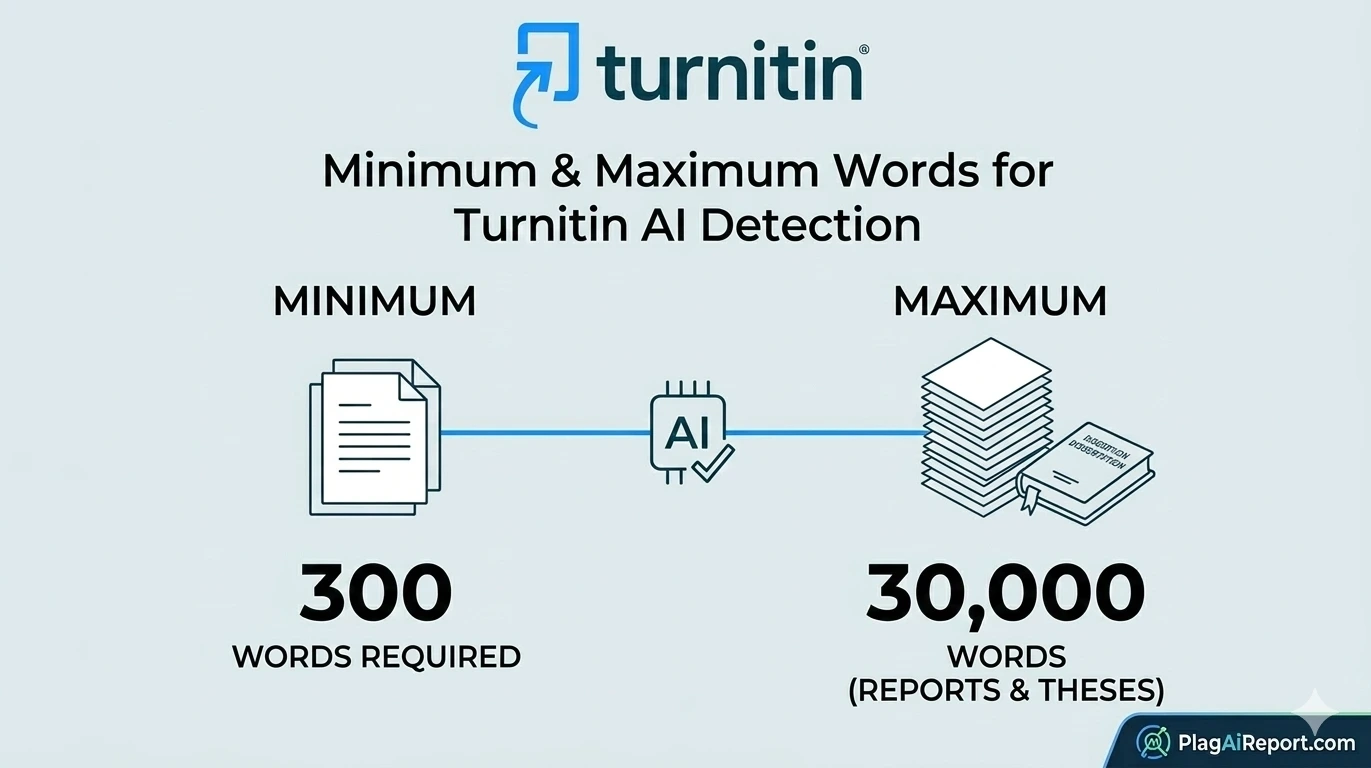
For Turnitin to generate an AI writing score, the submitted document must contain a minimum of 300 words of qualifying text.
While Turnitin originally experimented with lower thresholds, the 300-word limit was established to ensure a lower “false positive” rate. Qualifying text refers specifically to long-form prose—sentences and paragraphs where you are developing ideas. If your submission consists primarily of lists, tables, or bibliography entries, the system may still treat it as being below the minimum words for Turnitin AI detection.
When a document falls below this threshold, the AI detector remains inactive because there isn’t enough linguistic “signal” to determine whether the writing was generated by a human or a machine.
Why AI Detection Tools Need Enough Text
To understand how many words for Turnitin AI check are necessary, you have to look at how the technology functions. AI detectors utilize several core methodologies that require data:
- Linguistic Pattern Analysis: AI writing often follows a very predictable sequence. Detectors need several paragraphs to see if these patterns repeat or if there is the “burstiness” (variation in sentence length) typical of human writing.
- Sentence Structure Evaluation: Large Language Models (LLMs) tend to produce sentences of uniform length and complexity. A short sample of 50–100 words doesn’t provide enough variety for the tool to distinguish between a concise human and a repetitive AI.
- Statistical Probability Models: The system calculates the probability of the next word in a sequence. Below 300 words, the margin of error increases significantly, meaning a human could be unfairly flagged as a robot simply because they used common academic phrases in a short paragraph.
Is There a Maximum Word Limit for Turnitin AI Detection?
Yes, there is a Turnitin AI word limit, though it is generous enough to cover most academic assignments. As of current standards, Turnitin’s AI detector can process documents up to 30,000 words. This maximum was specifically increased from the previous 15,000-word limit to support long-form academic work like Master’s theses and doctoral dissertations.
This capacity is designed to accommodate:
- Full-length Master’s theses
- Doctoral dissertations
- Comprehensive research papers
If a document exceeds this 30,000-word limit, the AI report will fail to process entirely. Additionally, the file must be under 100 MB in size to ensure the processing engine can handle the data load.
Other reasons Why Turnitin May Not Show an AI Score
If your document meets the word count but you still don’t see a score, it is likely due to one of the following technical reasons:
- Unsupported Languages: As of 2026, Turnitin’s AI detector is specifically trained and optimized for English, Spanish, and Japanese. If your document is written in another language, the AI writing indicator will not be triggered. Learn more here.
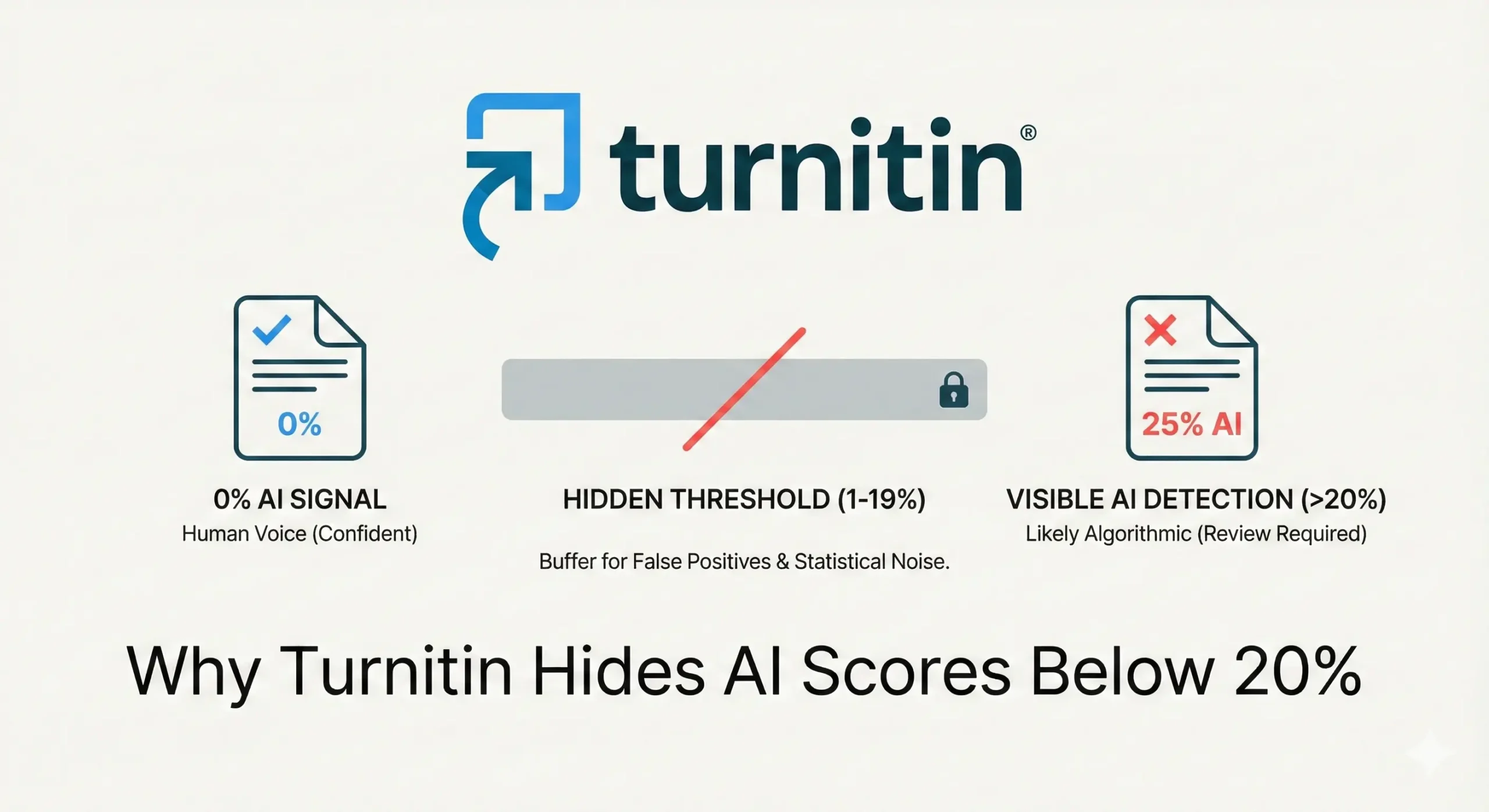
- The “Asterisk” Threshold (1–19%): To reduce the risk of “false positives,” Turnitin has implemented a safety buffer. If the system detects AI patterns at a level between 1% and 19%, it will display an asterisk (*%) instead of a specific number. This indicates that while some AI-like patterns were found, the confidence level is too low to provide a definitive percentage.
- Non-Prose Content: The AI model is built to analyze “qualifying text”—standard sentences and paragraphs. It cannot reliably process:
- Computer code or scripts.
- Poetry or dramatic scripts.
- Annotated bibliographies or reference lists (which are automatically excluded).
- Heavy use of bullet points and tables without accompanying prose.
- Gray Indicator Status: A gray icon in your report usually means the file did not meet the Turnitin AI detection text requirement.
Conclusion
To ensure a reliable result, aim for at least 300 – 30,000 words of standard prose in English, Spanish, or Japanese. Shorter or longer submissions, or those in unsupported languages will likely result in a gray indicator or an asterisk. Understanding these Turnitin AI report requirements helps you interpret your results with more confidence.
Frequently Asked Questions (FAQ)
The minimum requirement is 300 words of qualifying prose.
No, if the total qualifying text is under 300 words, the AI indicator will remain inactive.
It currently supports English, Spanish, and Japanese.
Yes, the current limit is 30,000 words.
An asterisk appears when the AI score is between 1% and 19%, indicating the result is not confident enough to display a specific percentage.
Was this helpful?