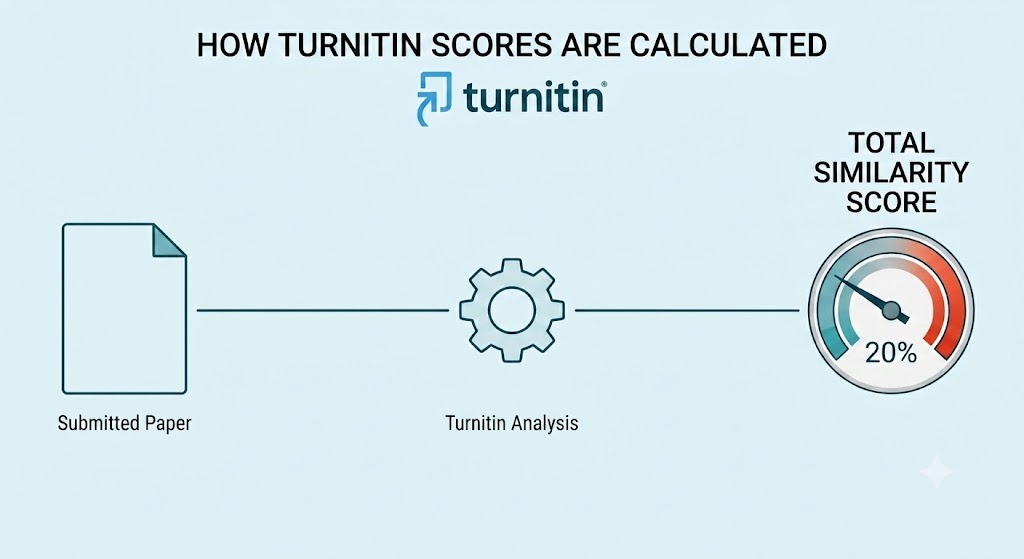
Most students think of Turnitin as producing one score. In reality, every submission processed through Turnitin can generate two completely independent scores: a similarity score and an AI writing detection score. These are calculated by entirely different systems, measure entirely different things, and should be interpreted in entirely different ways.
Understanding how each score is produced — not just what it means, but the actual mechanics behind the number — gives students and educators a much clearer picture of what Turnitin can and cannot tell them. This guide breaks down both calculations from the ground up.
Part One: How the Similarity Score Is Calculated
What the Similarity Score Measures
The similarity score represents the percentage of text in a submission that matches content found in Turnitin’s comparison database. According to Turnitin’s official guide for students, the formula is straightforward:
Similarity Score = (Matched Words ÷ Total Words in Submission) × 100
So if a 1,000-word paper contains 200 words that match sources in Turnitin’s database, the similarity score is 20%. The calculation itself is simple arithmetic. What makes interpretation complex is everything that goes into the numerator — the matched words.
Step 1 — Document Conversion
When a submission arrives, Turnitin first converts the file into plain text. Formatting, images, headers, footers, and layout information are stripped away, leaving only the raw sequence of words. This conversion ensures that the text comparison process is consistent regardless of whether the file was submitted as a Word document, PDF, or plain text file.
Step 2 — Breaking the Text Into Strings
Once the document is in plain text, Turnitin’s algorithm divides it into strings of consecutive words — sometimes called “fingerprints” or “shingles” in text-matching technology. Rather than comparing whole paragraphs at once, the system works on these smaller, overlapping word sequences. This approach makes it possible to detect partial matches, reordered sentences, and matches that span different parts of the submission.
Step 3 — Searching the Database
These text strings are then compared against Turnitin’s database, which is one of the largest collections of text ever assembled for this purpose. The database has three primary components:
- Internet content: Billions of current and archived web pages, including content that has since been taken offline.
- Academic publications: Thousands of journals, periodicals, and scholarly books from major publishers.
- Student paper repository: A collection of previously submitted student work from institutions around the world that use Turnitin. This is where the system identifies potential collusion between student submissions.
Every text string from the submission is checked against all three layers simultaneously.
Step 4 — Identifying and Overlapping Matches
When a match is found, Turnitin highlights the relevant passage in the submission and links it to the source. The system is also designed to de-duplicate overlapping matches — if the same passage matches both a web page and a journal article, Turnitin counts it only once in the final percentage. This prevents the same text from inflating the score multiple times.
Step 5 — Calculating the Final Percentage
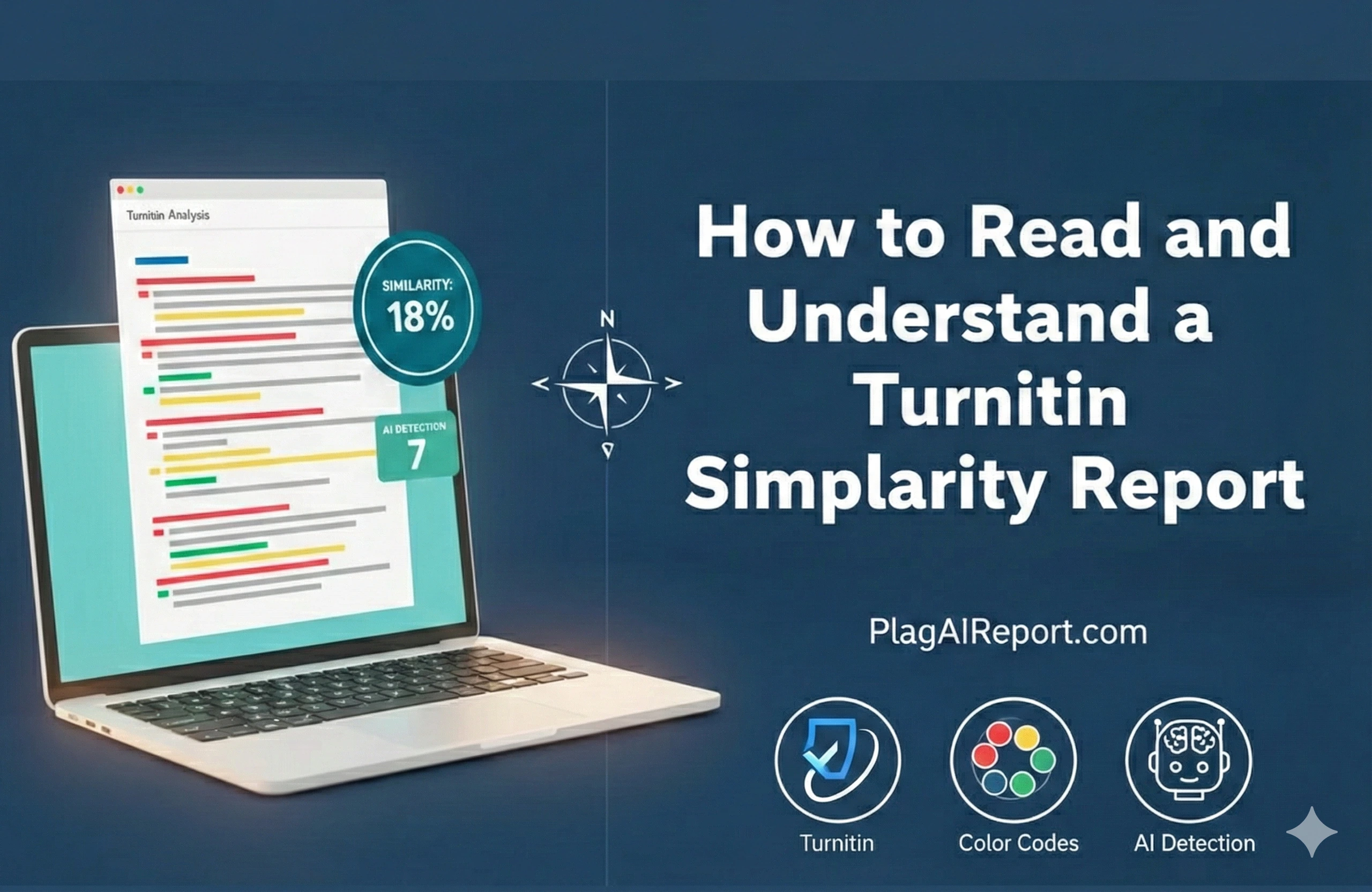
Once all matches are identified and de-duplicated, the total number of matched words is divided by the total word count of the submission, then multiplied by 100 to produce the percentage. The result is color-coded on a five-band scale:
- Blue: 0% — no matching text
- Green: 1% to 24% — low matching text
- Yellow: 25% to 49% — moderate matching text
- Orange: 50% to 74% — high matching text
- Red: 75% to 100% — very high matching text
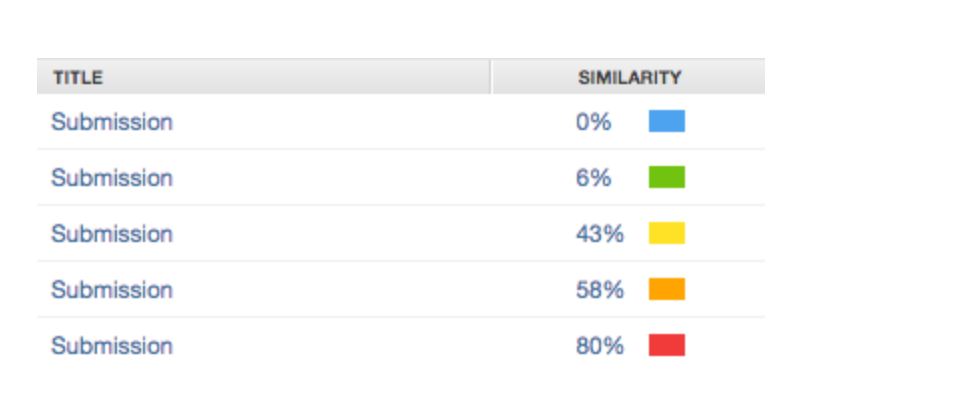
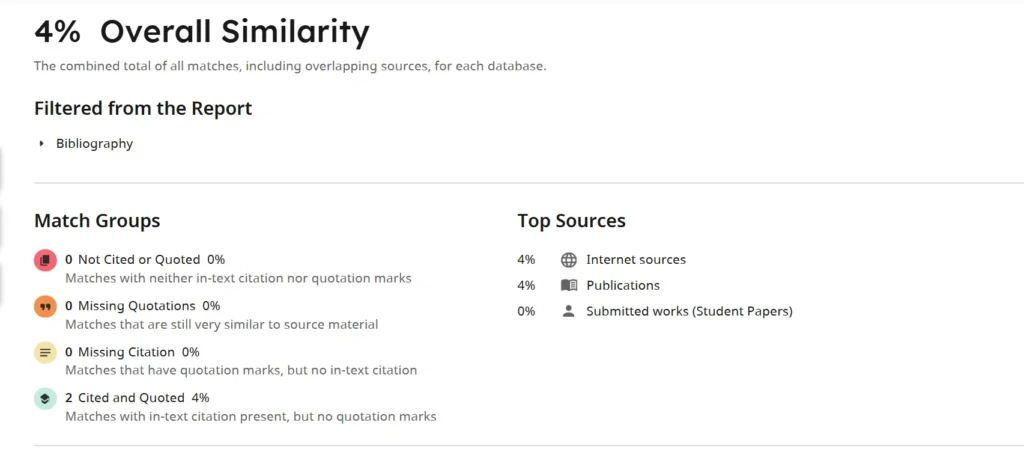
These color bands appear in the assignment inbox and give instructors a quick visual reference, though the bands themselves do not constitute a judgment about the work. As Turnitin’s official documentation states, the similarity score is a tool for review — not a plagiarism verdict. Learn more in our guide on whether a Turnitin similarity score means plagiarism.
What Gets Counted — and What Doesn’t
One of the most important things to understand about the similarity score is that it counts everything that matches, including:
- Correctly quoted sentences with proper citation marks
- Bibliography and reference list entries
- Standard academic phrases and boilerplate language
- The student’s own name or assignment headings
- Previously submitted drafts of the same paper
Instructors can apply filters to exclude quoted material, bibliographies, and small matches below a word-count threshold. When these filters are applied, the adjusted score can look significantly lower — and in many cases, more accurately reflects the genuinely unattributed portion of the paper. Understanding this is key to reading a Turnitin similarity report correctly.
How the AI Detection Score Is Calculated
The AI detection score is entirely independent of the similarity score. The two systems share no data, do not influence each other’s outputs, and appear in separate sections of the report. A paper can score 0% on similarity and still receive a high AI detection score, or vice versa.
Rather than comparing text against a database, Turnitin’s AI detection model analyzes writing patterns — specifically the statistical properties of the language itself.
The system works at the segment level. Submitted text is divided into overlapping segments of approximately 250 words, and each segment is analyzed by a neural classifier that evaluates signals such as:
- Perplexity: AI-generated text tends to choose statistically predictable words, producing low perplexity. Human writing is more varied and less predictable.
- Burstiness: Humans naturally vary sentence length and rhythm. AI text tends toward structural uniformity.
- Vocabulary distribution: AI models draw from consistent vocabulary patterns. Human writers use more idiosyncratic word choices.
Each segment receives a probability score. Segments above the detection threshold are classified as AI-generated, and the final score is the percentage of qualifying prose text classified as AI, weighted by segment length.
Turnitin only analyzes qualifying text — long-form prose sentences in essays, dissertations, and reports. Code, bullet points, tables, and short-form writing are excluded.
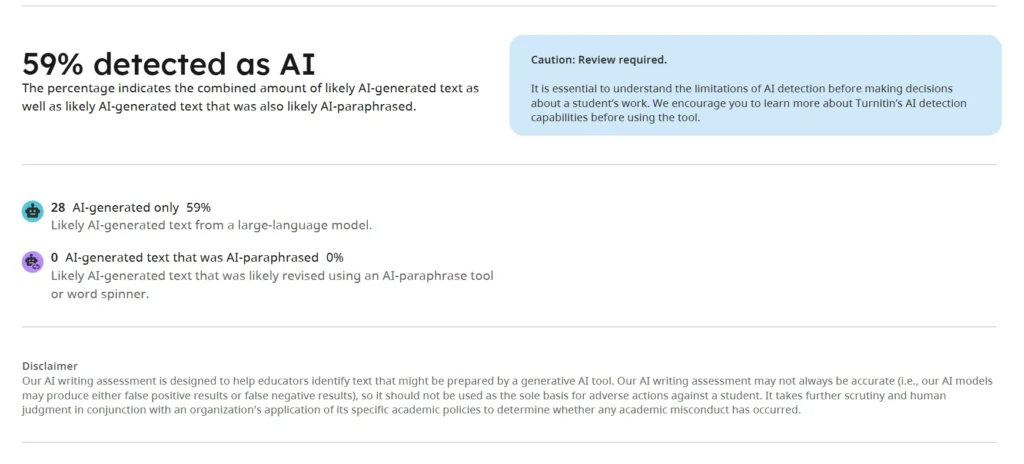
The Asterisk Below 20%
One important display rule: since July 2024, Turnitin no longer shows a numerical AI score for results between 1% and 19%. These appear instead as *%. This is because Turnitin’s own testing found a higher rate of false positives in this range — the risk of incorrectly flagging human writing as AI was too high to justify showing a number.
Only scores at 20% and above display as a percentage, alongside sentence-level highlights in the report. For a full explanation of what the asterisk means and when to worry about it, see the dedicated post on why Turnitin doesn’t show AI scores below 20%.
For a practical example of what an AI detection report looks like in full, see the Turnitin AI detection report example.
The Key Difference Between Both Scores at a Glance
| Similarity Score | AI Detection Score | |
|---|---|---|
| What it measures | Overlap with existing text in a database | Likelihood of AI generation based on writing patterns |
| Method | Text string matching | Machine learning segment classification |
| Counts citations? | Yes — all matches including cited ones | No — citations are irrelevant |
| Score display | Always 0–100% | *% below 20%; numeric percentage at 20%+ |
| Visible to students? | Usually, if instructor enables it | No — instructors only |
Neither score is a plagiarism verdict or a pass/fail result. Both are instruments designed to direct a human reviewer’s attention toward areas of the submission that warrant a closer look. Turnitin’s own documentation is explicit on this point — the AI score in particular should never be used as the sole basis for any adverse action against a student. For more on that, see the post on whether Turnitin’s AI detector is always accurate.
Conclusion
Turnitin’s similarity score is produced through a five-step text-matching process that compares word strings from a submission against a database of internet content, academic publications, and student papers. The final percentage is matched words divided by total words — but because that count includes citations, quotes, and references, the raw number always requires human review to interpret correctly.
The AI detection score works on a completely different principle: it analyzes linguistic patterns in prose text to estimate the probability that segments were generated by an AI model. It does not compare against a database — it reads the writing itself.
Understanding both calculations is what allows a student or educator to engage with a Turnitin report on its own terms, rather than reacting to a number without context.
Frequently Asked Questions (FAQ)
Turnitin divides the number of matched words in a submission by the total word count, then multiplies by 100. Matched words are identified by comparing text strings from the submission against Turnitin’s database of internet content, academic journals, and previously submitted student papers. All matches are counted, including correctly cited quotes and reference lists, unless an instructor applies exclusion filters.
Turnitin divides submitted prose into overlapping segments of approximately 250 words and runs each through a neural classifier. The classifier evaluates patterns such as word predictability, sentence uniformity, and vocabulary distribution. Segments that score above the detection threshold are classified as AI-generated, and the final score reflects the percentage of qualifying prose text in that category.
Because they measure different things. The similarity score looks for matching text — it is a database comparison problem. The AI score looks for the statistical fingerprints of machine-generated language — it is a pattern-recognition problem. The two systems operate independently and one cannot influence the other.
Yes. The two scores are entirely independent. A paper written entirely from scratch by an AI model with no copied passages could score 0% on similarity and 80% on AI detection. Conversely, a paper with heavy quoting from sources could score 40% similarity and 0% AI detection.
Was this helpful?