You submit your paper to Turnitin, wait for the report to process, and the number comes back: 20%. The icon is green. Your heart rate drops slightly — but then the second-guessing begins. Is 20% actually okay? Is it going to flag you for plagiarism? Will your instructor call you in?
These are some of the most commonly searched questions about Turnitin, and the confusion is completely understandable. A percentage feels like a verdict. It is not. A 20% similarity score means one-fifth of your submitted text matched something in Turnitin’s database — but whether that is a problem depends entirely on what those matches are and where they come from. This guide breaks it down clearly so you know exactly where you stand.
What Does a 20% Similarity Score Actually Mean?
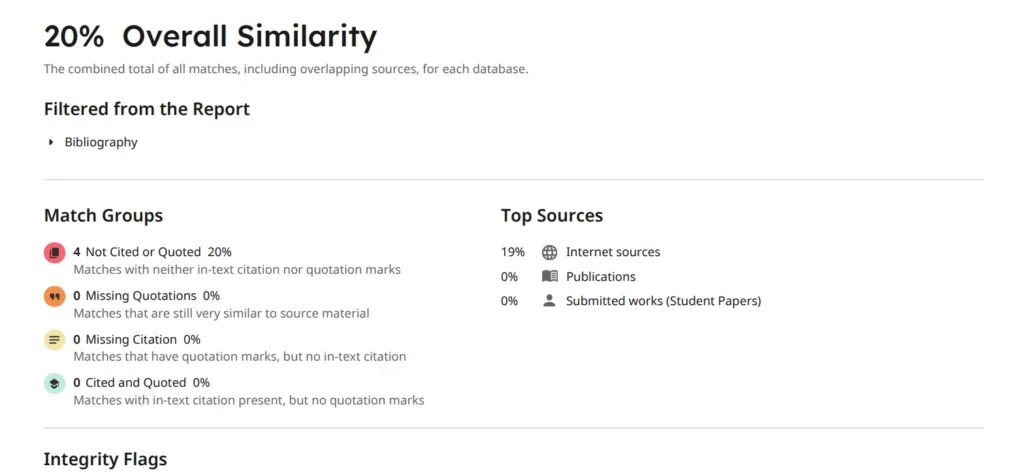
Before judging whether 20% is bad, it helps to understand what the number actually represents.
According to Turnitin’s official guide for students, the similarity score is calculated by dividing the number of matched words in your submission by the total word count. If your paper is 2,000 words long and 400 words match sources in Turnitin’s database, that is a 20% similarity score.
Critically, Turnitin does not check for plagiarism. What it does is compare your submission against a database that includes billions of internet pages, archived web content, academic journals and periodicals, and a repository of previously submitted student papers from institutions around the world. Anything that matches — whether it is a correctly quoted sentence, a reference list entry, a commonly used academic phrase, or an uncited copied paragraph — gets counted in the percentage.
This means a 20% score can represent two very different situations:
- Scenario A: A student who quoted four short passages from academic sources, cited every one correctly, and included a bibliography. Their references and quotes account for most of the 20% matches. This paper is absolutely fine.
- Scenario B: A student who copied two paragraphs directly from a website and failed to cite them. Those two paragraphs alone produced the 20% match — and that is a serious problem.
The number is identical. The context is completely different.
What Does the Green Color on a 20% Score Mean?
When you see a 20% similarity score, the icon in Turnitin’s Feedback Studio is green.
A 20% score falls squarely in the green band. This is the color most instructors associate with well-written, properly cited papers. But — and this is important — green does not mean cleared. It means low similarity. The instructor still opens the report and reviews the actual matches before making any judgment about your work. Read more about Turnitin color grades in this post on how to read and understand a Turnitin similarity report.
Is 20% a Good Similarity Score?
For most assignment types, a 20% score is considered low to moderate and entirely acceptable — provided the matches come from properly attributed sources. Here is how it breaks down by context:
- Standard essays and coursework: A score of 20% or below is widely regarded as the benchmark for well-written, well-cited work. Many academic librarians and writing instructors reference 15–20% as a reasonable range to aim for.
- Research papers with extensive quoting: A research paper that is required to include numerous direct quotes from primary sources will naturally carry a higher similarity percentage. A 20% score in this context is very low and suggests excellent paraphrasing discipline.
- Dissertations and theses: These documents typically involve thorough literature reviews and precise citations. Most institutions expect scores well below 20% for dissertations — some require under 10% — so a 20% score here may warrant a closer look, depending on how the matches are distributed.
- Technical and scientific papers: These papers frequently use standardized terminology, method descriptions, and formulaic language that may produce matches regardless of originality. A 20% score is generally acceptable.
What Turnitin itself makes clear is that there is no fixed universal threshold. The acceptable percentage is set by the institution and often by the instructor for a specific assignment. Some universities accept up to 20%, others allow only 10%, and some apply different limits to different assignment types.
When Can a 20% Score Be a Problem?
A 20% similarity score can raise concerns in specific circumstances. The number alone is not the issue — the source of the matches is.
The single-source problem is the most common red flag at any percentage. If your overall score is 20%, but 15% of that total comes from one single source, an instructor will notice. A large block of text matched to one website or paper suggests copying rather than research. Spread across a dozen properly cited sources, the same 20% score looks like exactly what good academic writing produces.
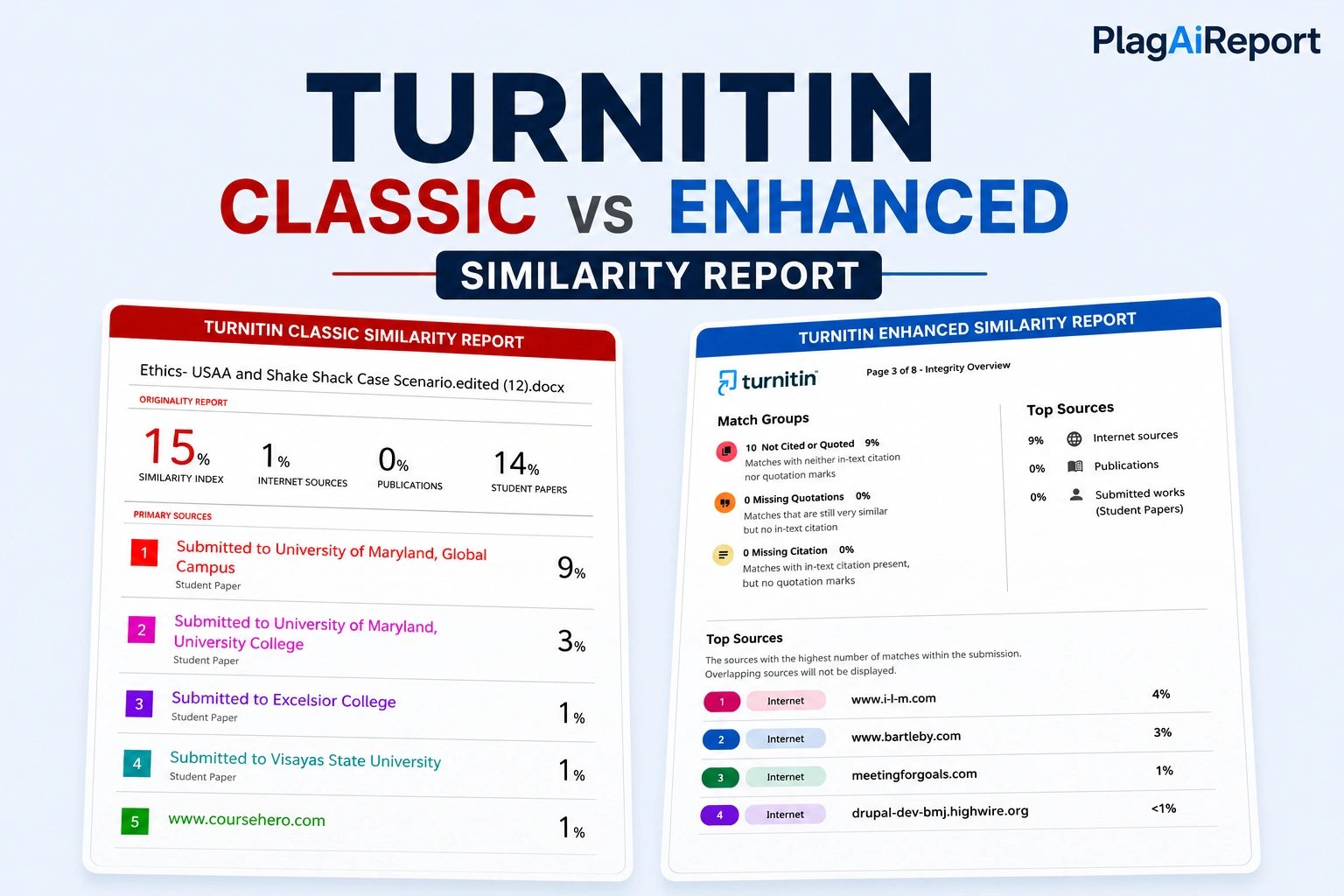
Uncited matches are the clearest pathway from a green score to a misconduct conversation. Turnitin’s Match Overview breaks down where each match originates. If matched text does not correspond to quotation marks or an in-text citation, that absence is visible to the instructor — regardless of what the overall percentage says.
Assignment-specific thresholds can also turn a 20% score into a problem. If your institution or instructor has set a 10% limit for a particular assignment and your score is 20%, you have exceeded their threshold even though 20% is generally considered acceptable elsewhere. Always check your assignment brief before submission.
For a deeper look at why a higher score is not always a problem either, the guide on why a high similarity score is not always plagiarism is worth reading before drawing any conclusions.
What Turnitin’s Own Example Says About 20%
Turnitin’s official instructor guide includes a specific scenario that addresses this exact score. It describes two students who each received a 20% similarity score on the same assignment. The first student copy-pasted a chunk of text from a source without attribution. The second student cited multiple sources correctly and used proper quotation marks throughout.
Both received 20%. Both are shown as green. Only one of them has a problem.
This example exists in Turnitin’s documentation precisely to make this point: the score is a starting point for review, not a conclusion. An instructor who only looks at the percentage and ignores the report details is not using Turnitin correctly. The score tells you where to look. The report details tell you what actually happened.
How to Check Whether Your 20% Is Fine
If you are looking at a 20% similarity report right now, here is a practical way to assess it:
- Open the Match Overview panel. This lists every source that your paper matched against, ranked by how much of your paper overlaps with each one. Check whether the matches are spread across multiple sources or concentrated in one.
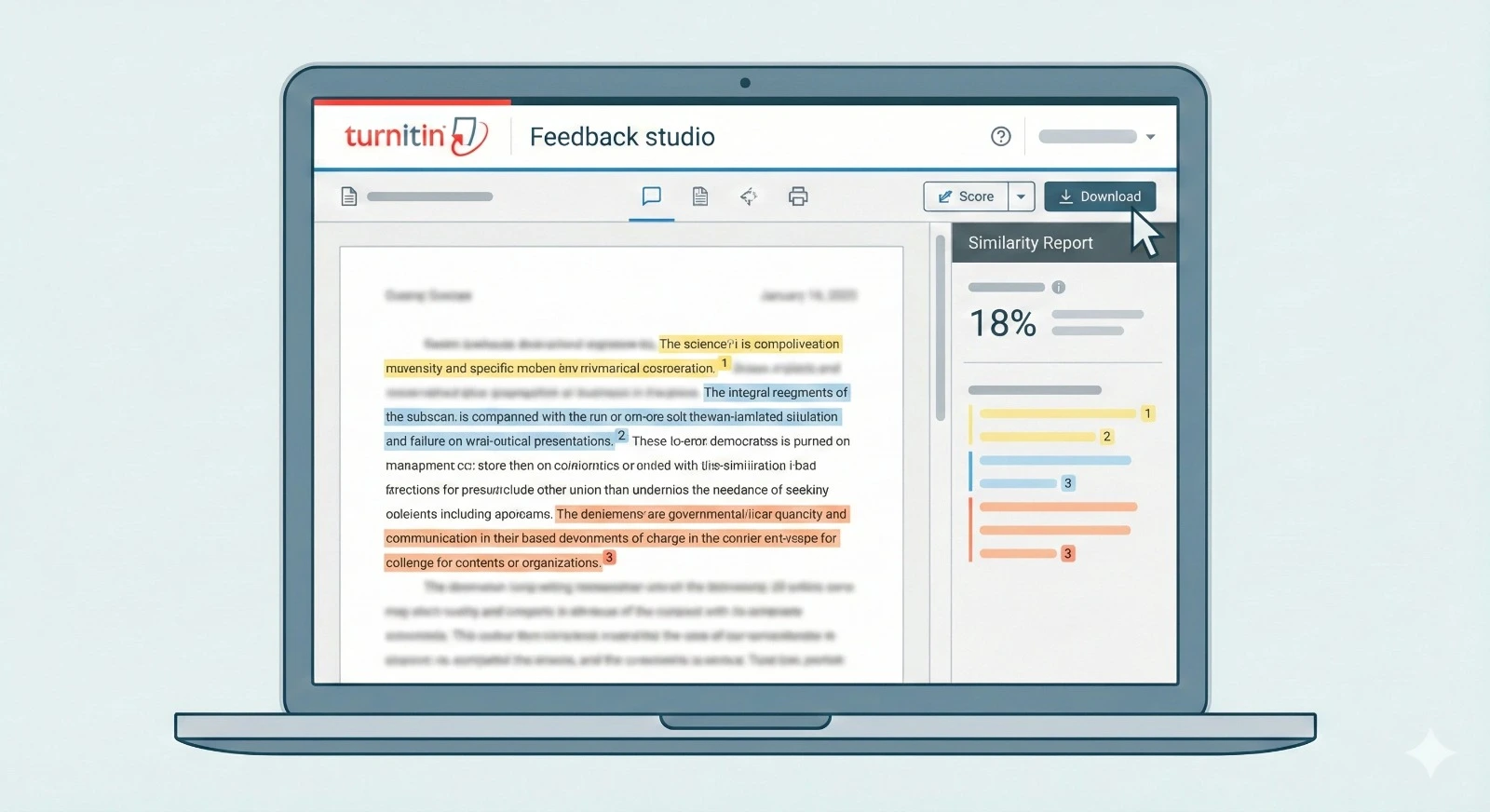
- Look at the highlighted text in your document. Each highlighted passage in the submission is linked to a source. Check whether those passages have quotation marks and citations in your paper.
- Check the largest single-source match. If one source accounts for more than 5–8% of your total similarity score, review that match carefully. A well-cited paper rarely has one source dominating the match list.
- Use the filter options. If your instructor has enabled it, try excluding bibliography entries and quoted text. If your score drops significantly when quotes and references are excluded, most of your similarity is from legitimate sources — which is a good sign.
- Cross-reference with your citation list. Every highlighted match should correspond to a source that appears in your reference list. Any match that does not is worth addressing before your instructor raises it.
If you want to see your report before submitting to your institution, getting a Turnitin report in advance is an option worth exploring.
Does a 0% Score Mean Your Paper Is Perfect?
Not necessarily — and this is a point many students miss. A 0% score means Turnitin found no matches in its database. For a research paper, a dissertation, or any document expected to engage with existing scholarship, a 0% score can actually raise questions. It may indicate that no sources were cited at all, that the document failed to process correctly, or that the bibliography was not included in the scanned text.
Turnitin’s student guide explicitly notes that zero similarity may indicate a lack of source-based evidence — which is a requirement for many assignment types. A small, well-distributed similarity score that reflects properly cited research often looks more credible to an instructor than a suspicious zero.
Conclusion
A 20% similarity score on Turnitin is not bad by itself. It sits comfortably in the green band — the range Turnitin associates with low similarity — and for the vast majority of assignment types, it is a perfectly acceptable result. What determines whether that 20% is fine or problematic is not the number: it is the composition of the matches behind it.
If the matches come from correctly cited quotes, reference list entries, and standard academic phrases spread across multiple sources, a 20% score is exactly what responsible academic writing produces. If the matches come from uncited blocks of copied text concentrated in one or two sources, even a 10% score can represent a serious problem.
The score is a signal to look. The report itself is where the answer lives. To understand every part of that report in detail, see the full guide on how to read and understand a Turnitin similarity report.
Frequently Asked Questions (FAQ)
Not automatically. A 20% score falls in Turnitin’s green band (1–24%), which indicates low similarity. Whether it is a problem depends on what the 20% consists of. If the matches come from properly cited quotes and references, it is generally acceptable. If the matches come from uncited copied text, even a low score can raise concerns.
There is no single universal answer. Most writing instructors and academic libraries reference 15–20% or below as a reasonable target for standard essays and coursework. For dissertations and theses, many institutions expect scores below 10%. The only threshold that truly matters is the one set by your institution or instructor for your specific assignment.
No. A green score means the similarity percentage is between 1% and 24%. It is a low reading, but it does not mean the report has been reviewed or cleared. An instructor still examines the matched text in detail before drawing any conclusions about academic integrity.
Yes, in specific circumstances. If a significant portion of the 20% comes from a single source without attribution, or if the assignment had a lower threshold (such as 10%), a 20% score could be subject to further review. The percentage alone does not determine the outcome — the context of the matches does.
Turnitin’s algorithm identifies matching text regardless of whether it is cited. A correctly quoted sentence with a proper citation will still appear as a match and contribute to the similarity score. This is expected and normal. Instructors are trained to distinguish between matches that represent citations and matches that represent uncited content.
Open the full similarity report and review the Match Overview panel. Check that every highlighted match corresponds to a properly cited source in your reference list. If any matched text is not cited, address it before submission or speak with your instructor for guidance.
Was this helpful?