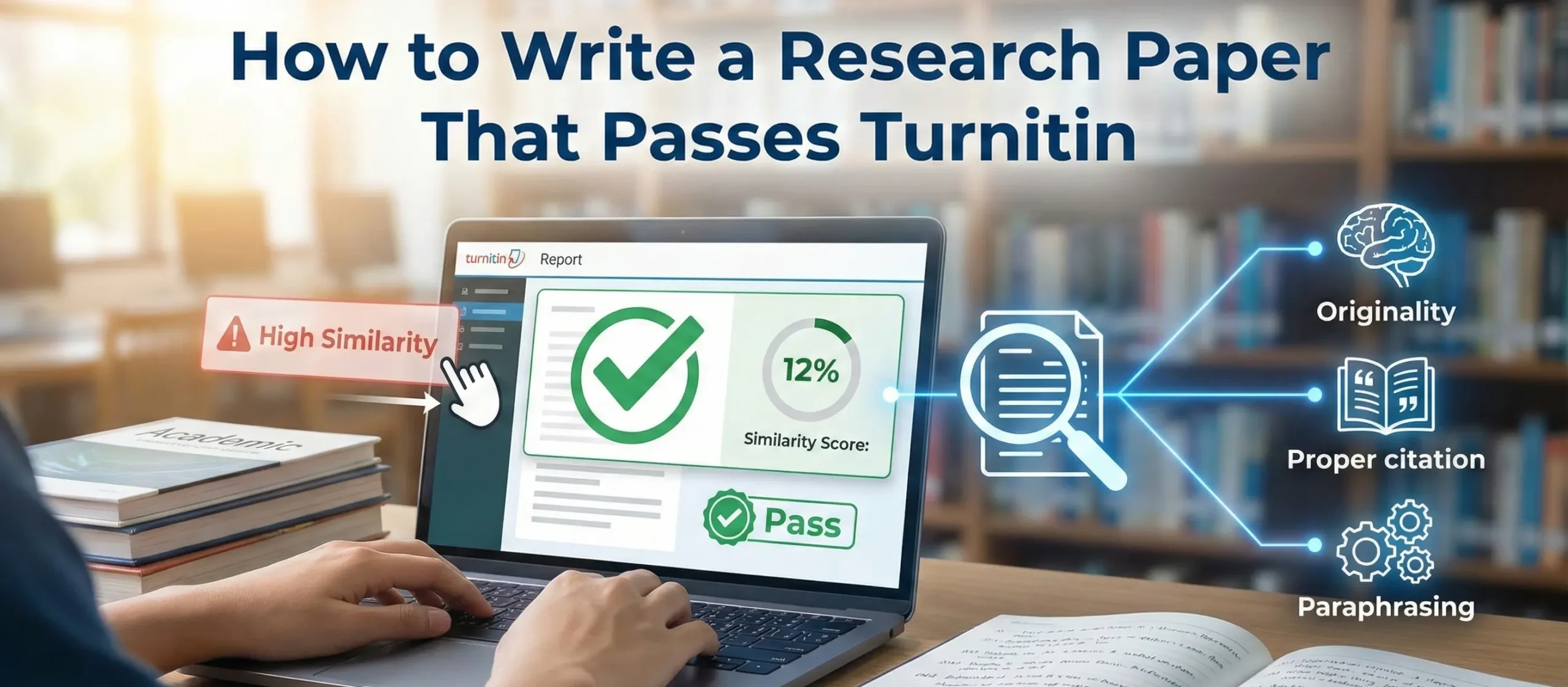
For many students and researchers, the moment of submitting a paper to Turnitin is filled with anxiety. You’ve spent weeks researching, drafting, and editing, only to worry that a piece of software might flag your hard work as “unoriginal.”
Here is the truth: Turnitin is not a trap designed to catch you out. It is a tool designed to verify integrity.
Many students believe that “passing” Turnitin requires complex tricks or hidden characters. In reality, passing Turnitin in 2025 is simply about writing ethically. It comes down to understanding the difference between copying ideas and engaging with them. When you understand how the software works, you stop writing to “beat the system” and start writing to communicate your research effectively.
In this guide, we will walk through exactly how to write a research paper that maintains academic integrity and produces a low similarity score naturally.
How Turnitin Evaluates a Research Paper
To write a paper that passes Turnitin, you first need to understand what the software actually sees.
Turnitin does not “read” your paper like a human professor. Instead, it uses complex algorithms to break your text into digital patterns and compares them against a massive database. As of 2025, this database includes:
- Billions of web pages (both live and archived).
- Millions of academic journals, books, and publications.
- A vast repository of student papers submitted by other universities globally.
Learn more about how turnitin detects plagiarism in this guide.
Understanding the Similarity Report When the check is complete, Turnitin generates a Similarity Report. This isn’t a grade; it’s a percentage indicating how much of your text matches sources in the database.
- Blue (No matching text): Rare and usually indicates no citations were used (which can be a bad sign for research papers).
- Green (1% – 24%): Generally considered an acceptable range, indicating minor matches like common phrases or properly cited quotes.
- Yellow (25% – 49%): Often a warning sign of poor paraphrasing or over-reliance on sources.
- Orange (50% – 74%) & Red (75% – 100%): Indicates significant issues, potentially plagiarism or a paper that has been submitted previously.
Read more: How to Read and Understand a Turnitin Similarity Report (2025 Guide)
Key Takeaway: A high score doesn’t automatically mean you plagiarized, and a low score doesn’t guarantee your work is perfect. It all depends on why the text matches.
What Causes High Similarity in Research Papers
If you wrote your paper yourself, why is your score high? This is the most common question we hear at PlagAiReport. High similarity usually stems from a few specific habits:
- Poor Paraphrasing (Patchwriting): This happens when you keep the original sentence structure but swap a few adjectives or verbs. Turnitin’s algorithms are sophisticated enough to detect sentence mapping.
- Quote Dumping: Using too many direct quotations instead of analyzing the information. Even if cited correctly, if 40% of your paper is quotes, your similarity score will reflect that.
- Bibliographies and Templates: Sometimes, the software flags your entire reference list or the standard cover sheet template used by your university.
- Self-Plagiarism: Submitting a paper (or parts of one) that you previously submitted to another class or institution.
Choosing and Using Sources Correctly
A strong research paper requires external evidence, but how you integrate that evidence determines your Turnitin score.
Aim for Variety Avoid relying heavily on one or two sources. If 30% of your paper comes from a single journal article, Turnitin will highlight large blocks of your text as matching that specific source. Instead, synthesize information from multiple credible academic sources (journals, books, databases) to support your argument.
The “Sandwich” Method Never let a source speak for itself. Use the “sandwich” method:
- Top Bun: Introduce the idea or claim.
- Meat: Provide the evidence (quote or paraphrase).
- Bottom Bun: Explain how this evidence supports your specific argument.
By wrapping sources in your own analysis, you naturally break up matching text with original writing.
How to Paraphrase Properly for Turnitin
Paraphrasing is the number one skill for lowering similarity scores. However, simply using an online “article spinner” or changing “said” to “stated” won’t work.
What Turnitin Checks Turnitin looks for strings of matching words and sentence structures. If your version mirrors the logic and syntax of the original too closely, it will be flagged.
How to Paraphrase Effectively:
- Read and Look Away: Read the original text until you understand the concept fully. Then, close the source and write the explanation from memory.
- Change the Structure: If the original is a complex sentence, break it into two simple ones. If it’s passive, make it active.
- Add Your Voice: Connect the idea to your specific thesis.
Example:
- Original: “The rapid expansion of digital marketing has forced traditional retailers to rethink their brick-and-mortar strategies.”
- Weak Paraphrase: “The fast growth of online marketing forced physical stores to reconsider their real-world strategies.” (High Similarity Risk)
- Strong Paraphrase: “Traditional retailers are being compelled to adapt their physical store models in response to the dominance of digital advertising channels.” (Low Similarity Risk)
For more techniques, you might want to read our guides on “How to Reduce Plagiarism in Your Paper Without Changing Meaning” and “The Difference Between Plagiarism, Paraphrasing, and Direct Quotes in a Turnitin Report“
Using Direct Quotes the Right Way
Direct quotes should be used sparingly—typically for definitions, specific data, or powerful statements that cannot be rephrased without losing impact.
The 10% Rule A good rule of thumb is to keep direct quotes under 10% of your total word count. If a paragraph contains more quoted text than original thought, rewrite it.
Formatting Matters Ensure you are using quotation marks ("") correctly. If you forget to close a quote, Turnitin might read the rest of the paragraph as part of the matched text. For longer quotes (usually 40+ words), use block quote formatting, which many instructors (and Turnitin settings) can be set to exclude from reports.
Citation Styles and Turnitin
Whether you use APA, MLA, Harvard, or Chicago style, correct formatting is non-negotiable.
In-Text Citations Turnitin scans for patterns. If you copy a statistic but fail to include the (Author, year) or footnote, the software sees it as an unoriginal string of text. Proper in-text citations signal to the reader (and the instructor reviewing the report) that the match is intentional and attributed.
The Reference List Often, a high similarity score is inflated by the bibliography. Since citations are standard, they will match thousands of other papers.
- Pro Tip: Check if your instructor has excluded bibliographies from the Turnitin settings. If not, don’t panic if your reference list glows red—instructors expect this.
Learn more: How to Properly Cite Sources Using APA, MLA, and Chicago Styles.
Editing and Reviewing Before Submission
Before you hand in your final draft, treat the editing phase as a “pre-flight check.”
- Check Your Paraphrasing: Read your paper against your main sources. Did you accidentally borrow a unique phrase?
- Review Quotations: Are all quotes enclosed in marks? Is the author cited immediately after?
- Run a Draft Check: This is the most effective step. By generating a preliminary report, you can see exactly what Turnitin sees.
This is where PlagAiReport helps. We allow you to check your paper privately. You can receive your official Turnitin similarity and/or AI detection reports delivered to your inbox within 5–10 minutes. This gives you the chance to fix issues before they become a permanent part of your academic record.
For help interpreting these results, check out our article: “How to Read and Understand a Turnitin Similarity Report (2025 Guide)”.
What to Do If Your Similarity Score Is High
You checked your paper, and the score is 35%. Don’t panic. A high score isn’t a failure; it’s feedback.
Step-by-Step Fix:
- Open the Report: Look at the color-coded matches.
- Exclude the Noise: Mentally filter out the bibliography and small common phrases.
- Identify the Problem: Is it one big block of text? That’s likely a quote or a cut-and-paste error. Rewrite it. Is it a “mosaic” of small matches? That’s likely poor paraphrasing.
- Revise: Go back to the specific sections and apply the paraphrasing techniques from Section 4.
For a deeper dive into this, read “Why a High Similarity Score Isn’t Always Plagiarism”.
Conclusion
Writing a research paper that passes Turnitin isn’t about outsmarting an algorithm; it’s about demonstrating your own understanding. When you paraphrase thoughtfully, cite meticulously, and prioritize original analysis, a low similarity score will follow naturally.
Remember, Turnitin is there to verify your hard work, not to discount it. By following these steps, you can submit your paper with confidence, knowing it represents your own authentic scholarship.
Frequently Asked Questions
What similarity score is acceptable for a research paper? Most universities consider a score below 15–20% to be acceptable. However, this varies by institution and assignment type. A thesis or dissertation often requires a score below 10%. Always check your specific department’s guidelines.
Can a properly cited paper still have similarity? Yes. Turnitin detects matching text, not just plagiarism. If you use direct quotes and a bibliography, they will show up as matches. Instructors are trained to ignore properly cited matches.
Does Turnitin detect paraphrasing? Yes. Modern algorithms (and AI detection tools) can identify “patchwriting,” where only a few words are changed. To pass, you must change the sentence structure and vocabulary significantly.
How can I lower similarity without changing meaning? Read the original text, put it away, and write the concept as if you were explaining it to a friend. Use different sentence structures (e.g., changing active voice to passive) and combine multiple sources into one synthesis.
Does Turnitin check reference lists? Yes, Turnitin scans reference lists, and they often generate high similarity matches because citations follow standard formats. Many instructors choose to exclude the bibliography from the final score, but the software scans it by default.
Was this helpful?