Introduction
Whether you are a student submitting a thesis, a researcher aiming for publication, or a professional content writer, an accusation of plagiarism can be devastating.
The definition of “originality” has changed. Students and writers aren’t just worried about accidentally copying a sentence from Wikipedia; they are worried about being accused of using AI.
With the explosion of tools like ChatGPT, Gemini, and Claude, the battle for integrity has shifted. Now, the two biggest names in the industry—Turnitin and Grammarly—aren’t just checking for matching text. They are hunting for robotic writing patterns.
But are they equally accurate? Does Grammarly’s “AI check” see the same thing as your professor’s Turnitin report?
In this comprehensive guide, we compare Turnitin and Grammarly on both fronts: Plagiarism and AI Detection. We will explain why a “clean” report on one might still get you flagged on the other.
How Plagiarism and AI Detection Tools Work
To understand the difference, you must understand the technology.
1. Plagiarism (Similarity) Detection: This is the classic “fingerprinting” method. Tools break your text into chunks and compare them against massive databases of websites, books, and journals. If a sentence matches, it gets flagged.
2. AI Writing Detection: This is completely different. The software doesn’t look for matches; it looks for patterns.
- Perplexity: How surprised the model is by your word choice. (AI is rarely surprised; it chooses the most probable next word).
- Burstiness: The variation in sentence structure. (Humans are “bursty” and chaotic; AI is monotonous and steady).
Both Turnitin and Grammarly now attempt to measure these.
Evaluation Criteria Used in This Comparison
To ensure a fair and neutral review, we evaluated both tools based on the following metrics:
- Database Scope: Does it check just the internet, or does it see behind paywalls (journals, books)?
- Student Repository Access: Can it detect if a student copied a paper submitted to a different university?
- Accuracy & Sensitivity: Does it catch paraphrased text, or only exact matches?
- False Positives: How often they incorrectly flag human writing as AI.
- Accessibility: Can you buy it yourself, or do you need an institution?
- Reporting: How clear and actionable is the final report?
Turnitin Plagiarism Checker
Turnitin Overview
Turnitin is an institutional tool designed primarily for educators and universities. It is not sold directly to students. Its primary goal is to maintain academic integrity by preventing students from copying from the web, journals, or each other.
The “Repository” Advantage
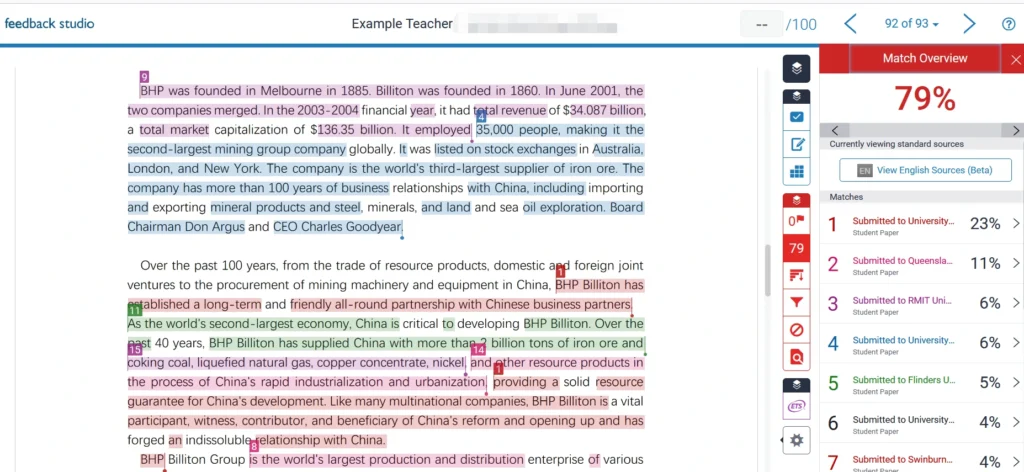
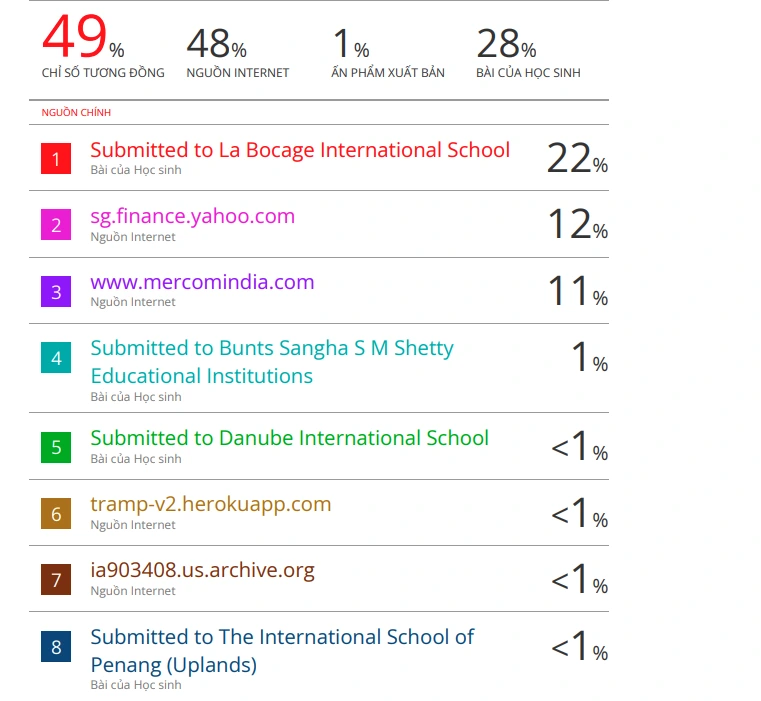
The true power of Turnitin lies in its Student Paper Repository. When a student submits a paper to Turnitin, it is often saved in a global database. If another student at a different university tries to submit that same paper (or parts of it) years later, Turnitin will flag it. No other public plagiarism checker has access to this internal database.
Learn more about Turnitin repositories in this blog and why it is safe to use PlagAiReport, since we check students’ papers using the no-repository option, which does not store a student’s paper in Turnitin’s database.
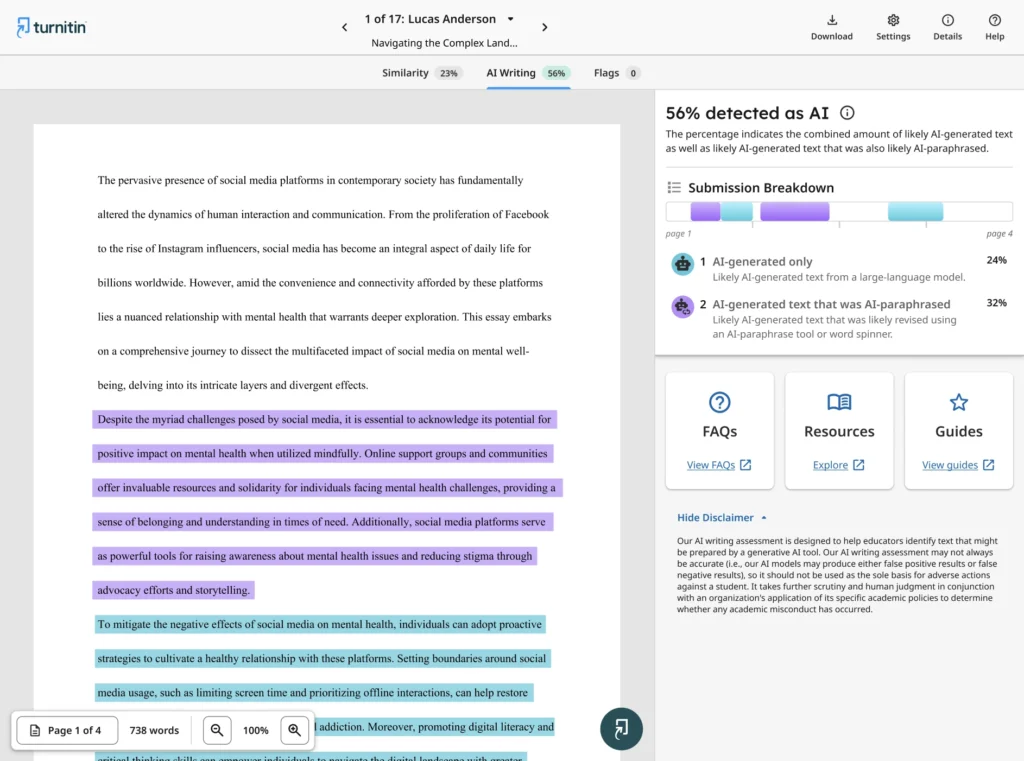
Turnitin AI Detection
Turnitin launched its dedicated AI detection capability to identify content generated by LLMs (Large Language Models).
- Separate Score: You get a Similarity report (plagiarism) and an AI Writing report (percentage of text likely generated by AI).
- High Sensitivity: It is aggressively tuned to catch ChatGPT and paraphrased AI text.
- The “False Positive” Risk: Because it is so sensitive, it can sometimes flag writing that is simply formulaic or heavily edited by grammar checkers.
Read more: Can Turnitin Detect AI-Generated Content?
Pros:
- Unrivaled Database: Checks 99+ billion web pages, 1.8+ billion student papers, and 89+ million scholarly journals (Crossref, Elsevier, Springer, etc.).
- Paraphrasing Detection: Excellent at spotting text that has been slightly tweaked or “spun.”
- Strict Standards: The standard for 98% of universities globally.
Cons:
- Not Publicly Accessible: You cannot simply sign up and scan a paper; you usually need an instructor or a service like plagaireport.com to access Turnitin reports.
- Strictness: Can flag common phrases or bibliography items if not configured correctly (causing “false positives”).
Grammarly
Grammarly Overview
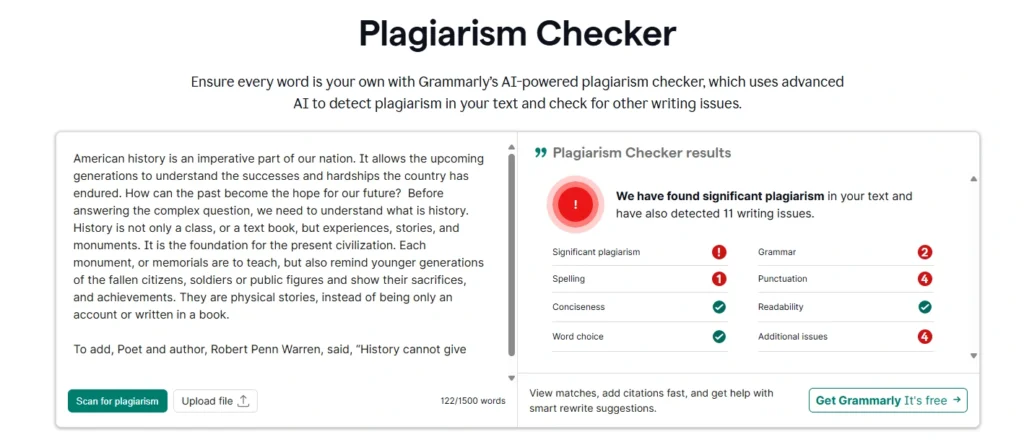
Grammarly is first and foremost a writing assistant. Its plagiarism checker is an add-on feature available in its Premium plan. It is designed for writers, bloggers, and professionals who want to ensure their content is original before publishing online.
Plagiarism Capabilities
- Web-Centric: Grammarly is excellent at scanning the open web (blogs, Wikipedia, news sites).
- ProQuest Partnership: It has access to the ProQuest academic database, giving it more depth than free tools, but it still lacks Turnitin’s student paper repository.
Grammarly AI Detection
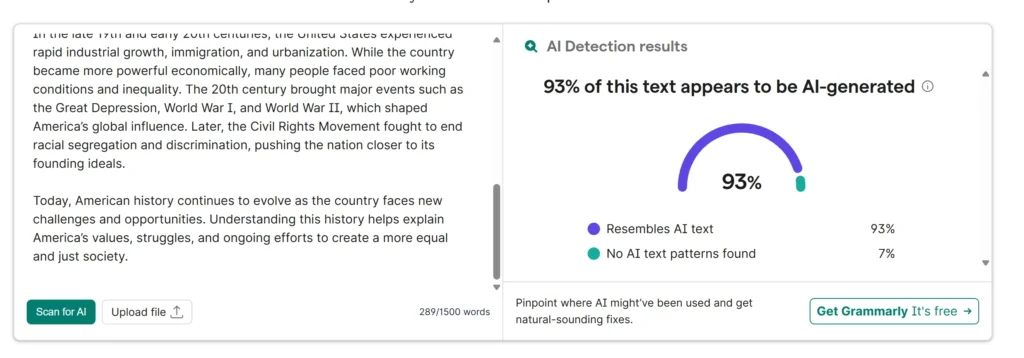
Grammarly takes a “transparency” approach.
- Authorship & Transparency: Instead of just catching cheaters, Grammarly focuses on Authorship. It can track your typing process in Google Docs/Word to prove you wrote the text yourself.
- The “GenAI” Detector: It offers a percentage score indicating how much text appears AI-generated. However, it is generally less aggressive than Turnitin. It often gives the benefit of the doubt to the writer.
Comparison Table: Turnitin Vs Grammarly
| Feature | Turnitin | Grammarly |
| Primary Use | Academic Policing | Writing Enhancement |
| Plagiarism Database | Web + Journals + Student Repository | Web + ProQuest |
| Peer-to-Peer Checking | Yes (Checks other students) | No |
| AI Detection Stance | Aggressive (Catch the cheater) | Passive (Inform the writer) |
| AI Detection Accuracy | High sensitivity (can flag editing) | Moderate (misses mixed AI) |
| Accessibility | Institutional Only | Public (Paid Subscription) |
| Best For | Final Submission Verification | Drafting & Polishing |
Common Misconceptions
1. “I paraphrased the AI text, so I’m safe.” Turnitin’s AI detector looks for syntax patterns, not just keywords. Simple paraphrasing (changing “happy” to “glad”) often fails to fool the detector because the structure of the sentence remains robotic.
Turnitin can show a percentage indicating how much of the content appears to be paraphrased or humanized from AI-generated text, rather than fully human-written. This means content processed through AI humanizers or paraphrasing tools can still be partially flagged.
For a deeper breakdown, see: Can Turnitin Detect AI humanizing tools Content?
2. “Grammarly said 100% Original, so Turnitin will too.” False. Grammarly does not check against the global Turnitin student database. If you bought an essay or copied a friend’s old paper, Grammarly will likely miss it, but Turnitin will catch it instantly.
3. “Turnitin proves I cheated.” No tool is perfect. Turnitin reports are probabilities, not proofs. However, professors tend to trust the Turnitin report over a student’s word, which is why pre-checking is valuable.
Which Tool Should You Use?
Use Turnitin if:
- You are submitting to a university or academic journal.
- You need to check for “Student Paper” matches (peer plagiarism).
- You want to see your AI Score exactly as your professor will see it.
- You are worried that your use of tools like Quillbot or Grammarly has triggered false AI flags.
If you don’t have institutional access, PlagAiReport offers reliable Turnitin reports to students at an affordable cost, using authentic institutional checks. This allows you to review similarity scores, AI detection results, and paraphrased AI percentages before submission—so there are no surprises.
Use Grammarly if:
- You are a blogger, copywriter, or SEO professional.
- You want to improve your writing style while checking for basic web plagiarism.
- You need to generate citations automatically.
- You want to prove “Authorship” by tracking your version history (using Grammarly’s Authorship tool).
The Verdict: For writers, Grammarly is the superior tool. For students, Turnitin is the only metric that counts. Relying on Grammarly to predict a Turnitin result is risky.
Final Thoughts
In the era of AI, “originality” is harder to prove. Plagiarism checkers have evolved into “Authenticity Detectors.”
While Grammarly is a fantastic companion for writing, Turnitin remains the ultimate judge in academia. If you have access to a Turnitin report (via your institution or a legitimate service), it is the only way to be 100% sure of your submission’s status before the deadline.
Frequently Asked Questions (FAQs)
Does Grammarly’s plagiarism checker detect AI? Grammarly has a separate feature for AI detection. Its standard plagiarism checker only looks for copied text. You must check the “AI” section of the report specifically.
Can Turnitin detect if I used Grammarly to rewrite my essay? Often, yes. If you use Grammarly’s “GenAI” features to rewrite large chunks of text, Turnitin may flag it as AI-generated because the sentence structures become too predictable and polished.
Why is Turnitin’s AI score different from Grammarly’s? They use different training models. Turnitin is trained specifically on academic writing and essay mills, while Grammarly is trained on a broader mix of internet writing. Turnitin is generally more sensitive.
Is 0% AI score possible on Turnitin? Yes, but even human writing sometimes triggers a 1-2% false positive. Most universities consider scores under 15-20% as negligible, provided the content makes sense.
Was this helpful?