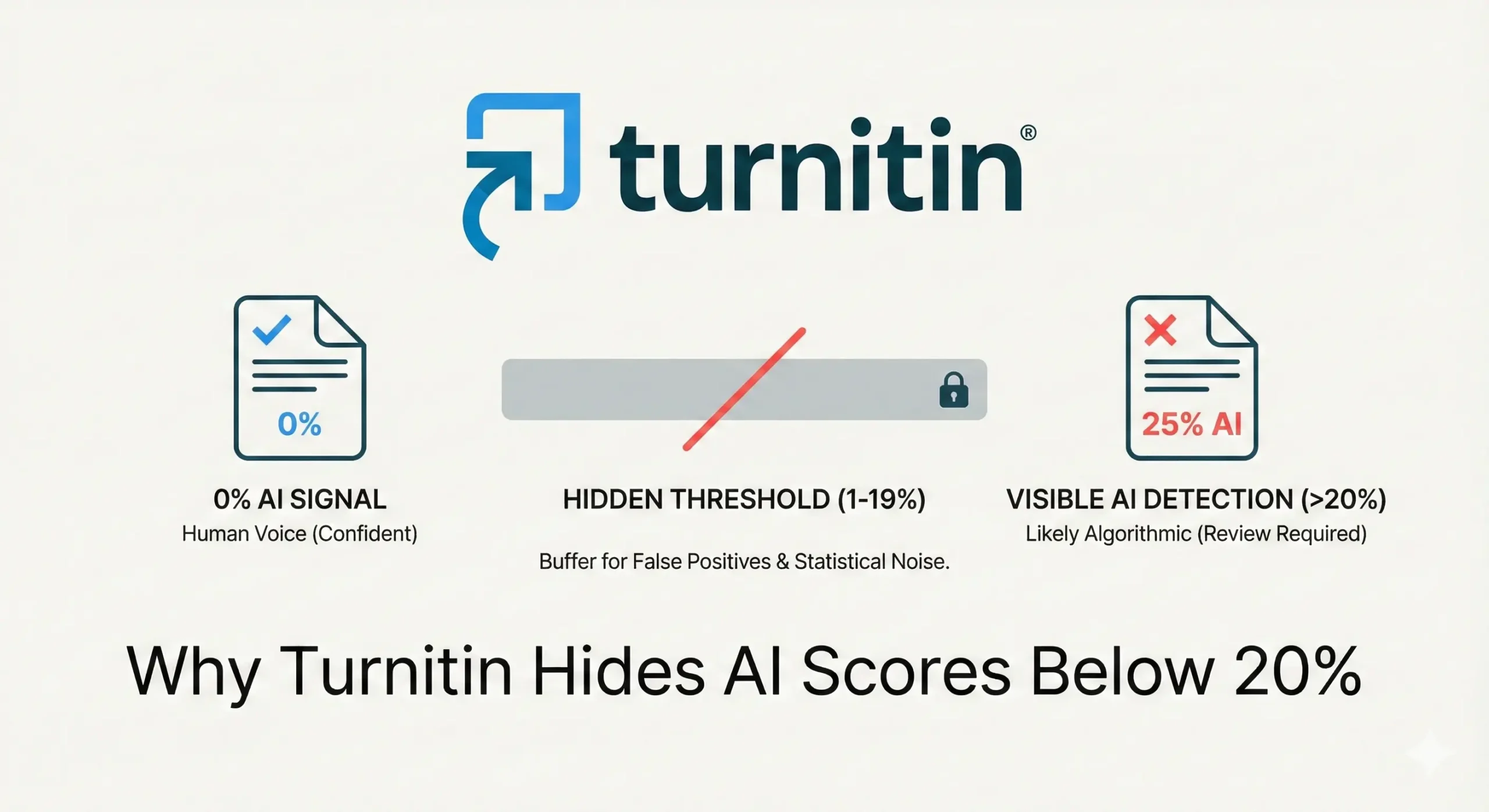
Why Turnitin Doesn’t Show AI Scores Below 20% — What *% Means

# Why Turnitin Doesn’t Show AI Scores Below 20% — And What That Means The integration of artificial intelligence into academic writing has fundamentally changed how students produce work and how educators evaluate it. Among the tools at the forefront of this shift is Turnitin’s AI detection feature. However, many students and researchers are left puzzled when they receive a report that shows 0% AI, while they know that the system often ignores scores between 1% and 19%. Understanding the mechanics behind this hidden threshold is essential for maintaining academic integrity and reducing the anxiety often associated with automated reports. This guide breaks down why Turnitin implements a 20% visibility threshold, what a 0% score actually signifies, and how to interpret these results through a lens of statistical probability. --- ## 1. How Turnitin AI Detection Works A High-Level Overview To understand the 20% threshold, one must first understand how Turnitin sees AI. Unlike plagiarism detection, which compares text against a massive database of existing documents to find matches, AI detection is probabilistic. ### Linguistic Predictability and Perplexity Turnitin’s AI writing detection model is trained to identify the hallmarks of Large Language Models (LLMs) like GPT-4. AI models generate text by predicting the next most likely word in a sequence. This results in writing that has low perplexity (it is very predictable) and low burstiness (the sentence structure and length are very uniform). ### Structural Analysis The detector looks at patterns. Humans tend to write with noise—we use idioms incorrectly, vary our sentence lengths drastically, and weave in personal anecdotes or unconventional logic. AI, by contrast, is highly structured and consistent. Turnitin’s algorithm assigns a probability score to each segment of a document, determining how likely it is that the segment was generated by an algorithm rather than a human mind. --- ## 2. Why Turnitin Shows 0% but Hides 1–19% One of the most common questions from students is If Turnitin can detect 15% AI, why does it tell me it's 0% or show nothing at all There is a vital distinction between a 0% score and a sub-20% score. ### 0% AI The Absence of Signal When a report displays 0% AI, it indicates that the system found no detectable AI signal. The linguistic patterns throughout the paper do not match the mathematical signature of an LLM. In this case, the detector is confident that the writing style is human-consistent. ### 1–19% AI The Weak Signal If the detector finds that, for example, 12% of a paper looks like AI, it does not surface that number. Instead, it effectively hides the score. This is because Turnitin considers scores below 20% to be statistically unreliable. At these low levels, the signal of AI is so weak that it is indistinguishable from noise (human writing that happens to look robotic). ### The Logic of the Threshold Turnitin intentionally sets a buffer zone to prevent unnecessary confrontations between students and faculty. By not surfacing these low scores, the system acknowledges that its confidence level is not high enough to warrant an accusation of academic misconduct. --- ## 3. Understanding False Positives in AI Detection The primary reason for the 20% threshold is the risk of false positives. A false positive occurs when the software flags human-written text as AI-generated. ### Why Does Human Writing Look Like AI Several factors can cause a human-written document to trigger AI detection flags Highly Formal Academic Tone Academic writing requires a level of precision and standardized phrasing that can mimic the predictability of AI. Non-Native English Structures Students writing in their second or third language may rely on standard grammatical templates or simpler sentence structures that AI models also favor. Repetitive Phrasing Technical papers or scientific reports often require the repetition of specific terminology, which can lower the perplexity of the text. Strict Adherence to Templates If a student follows a very rigid essay template provided by an instructor, the resulting structure may appear algorithmic. Because these factors are common in high-quality academic work, a threshold is necessary to protect students who write clearly and formally. --- ## 4. Breaking Down Turnitin’s Official Message When a score is below 20%, Turnitin provides a disclaimer that acts as a safeguard for both students and educators. Let's analyze the core of their official stance AI detection includes the possibility of false positives. Although some text in this submission is likely AI generated, scores below the 20% threshold are not surfaced because they have a higher likelihood of false positives. ### Possibility of False Positives This is a candid admission that the technology is not infallible. It reminds the user that the report is an indication, not a verdict. ### Likely AI Generated This phrase refers to the statistical probability. Even if the system thinks a paragraph is AI, it acknowledges that likely is not certainly. ### Higher Likelihood of False Positives This is the mathematical justification for the 20% rule. Statistical modeling shows that as the percentage of detected AI decreases, the error rate increases. By cutting off the display at 20%, Turnitin ensures that when a report does show a score, the probability of it being an error is significantly lower. --- ## 5. Should You Worry About a Hidden AI Score In short Usually, no. If your report does not show an AI score, or if you are aware that it fell into the hidden sub-20% category, it is rarely a cause for concern. In the context of a 2,000-word essay, 15% would represent only a few paragraphs. Such a small amount of AI-like text is often just the result of a student using standard introductory phrases, bibliographies, or technical descriptions. The threshold is designed to focus attention on significant uses of AI. Educators are generally advised to look for high-confidence flags rather than chasing marginal percentages that are likely the result of a student’s formal writing style. --- ## 6. How Educators Use AI Scores It is important to remember that Turnitin is a support tool, not an automated judge. Educational institutions are increasingly adopting policies that favor human judgment over raw percentages. Contextual Review If a score exceeds 20%, an instructor should look at which parts are flagged. Are they the student's original arguments or just the methodology section Preventing Misuse The 20% threshold prevents over-policing. It forces a level of tolerance for the natural overlap between human and machine writing. Holistic Assessment Educators are encouraged to compare the flagged work against a student's previous writing style and their performance in class discussions. --- ## 7. Common Misconceptions About Turnitin AI Detection To navigate academic integrity in 2025, we must debunk several myths Myth Reality --- --- A hidden score means I cheated but got away with it. No. A hidden score usually means your writing style was formal enough to create a false alarm. Any AI detection equals misconduct. AI tools are often used for grammar checking or brainstorming; detection does not automatically equal a breach of integrity. AI scores are 100% accurate. No AI detector is 100% accurate. They are probability engines, not truth-detectors. 0% AI means no tools were used. Not necessarily. It means no generative AI patterns were detected. It doesn't account for simple spell-checkers. --- ## Final Thoughts The 20% Threshold Is a Safeguard, Not a Warning The 20% threshold implemented by Turnitin is a crucial feature designed to protect the academic community. By refusing to surface low-confidence scores, the system reduces the noise of false positives and ensures that investigations into academic integrity are based on substantial evidence rather than statistical quirks. For students, a score of 0% or a hidden sub-20% result should be seen as a validation of their unique human voice. It indicates that your writing possesses the complexity, variation, and nuance that current AI models simply cannot replicate. --- ## FAQ Section ### Why does Turnitin show 0% AI but hide other low scores Turnitin shows 0% when there is no detectable AI signal at all. It hides scores between 1% and 19% because at those levels, the software cannot distinguish between actual AI use and a human writer using a formal, robotic tone. ### Does a hidden AI score mean Turnitin detected AI It means the system found weak patterns that resemble AI, but the confidence level is too low to be considered reliable. In most cases, these weak signals are just human writing that happens to be highly structured. ### Can Turnitin falsely detect AI in human writing Yes. This is why the 20% threshold exists. Highly technical, non-native English, or extremely formal writing is most susceptible to being falsely flagged. ### Is the 20% threshold fixed or adjustable As of now, the 20% threshold is a standard setting within Turnitin's AI detection model to ensure a baseline of reliability across all institutional reports. ### Should instructors penalize based on AI percentages Most academic policies state that AI scores should be the beginning of a conversation, not the end. A percentage alone is not proof of misconduct; it requires a manual review by the instructor. --- Would you like me to generate a meta-description or social media snippets to help promote this blog post on your channels

The rapid rise of AI writing tools has changed both how academic work is produced and how it is evaluated. To respond to this shift, Turnitin introduced an AI detection feature designed to estimate whether parts of a submission were likely generated by artificial intelligence.

However, many students and researchers are puzzled when they receive a Turnitin report that does not show a numerical AI percentage, but instead displays the message *% detected as AI” — especially when they expect to see a clear score like 5%, 12%, or 18%.

This confusion often stems from a lack of awareness of how Turnitin’s AI visibility threshold works.

In reality, a Turnitin AI report does not display AI scores between 1% and 19%, even though its system may internally detect weak AI-like patterns. At the same time, it does display 0% AI when no AI signal is detected at all, and it clearly shows percentages once the score reaches 20% or higher.

This article explains:

  • Why Turnitin hides AI scores below 20%
  • What the “*% detected as AI” message actually means
  • Why 0% AI is treated differently
  • How students and educators should interpret these results responsibly

1. How Turnitin AI Detection Works: A High-Level Overview

To understand the 20% threshold, one must first understand how Turnitin “sees” AI. Unlike plagiarism (similarity) detection, which compares text against a massive database of existing documents to find matches, AI detection is probabilistic.

Turnitin’s AI model analyzes linguistic patterns commonly produced by large language models (LLMs), such as ChatGPT. These models tend to generate text that is:

  • Highly predictable (low perplexity)
  • Structurally consistent
  • Uniform in tone and sentence length

Human writing, by contrast, usually contains more variation, inconsistency, and stylistic “noise.”

Turnitin examines segments of text and assigns probability scores based on how closely they resemble AI-generated language. These probabilities are then aggregated into an overall estimate.

Importantly, this process does not prove AI use — it only estimates likelihood.

2. Why Turnitin Shows 0% but Hides Scores Between 1% and 19%

This is the most misunderstood part of Turnitin’s AI reports.

0% AI: No Detectable Signal

When Turnitin displays 0% AI, it means the system found no statistically meaningful AI-generated patterns in the text.

In other words, the linguistic patterns throughout the paper do not match the mathematical signature of an LLM. In this case, the detector is confident that the writing style is human-consistent.
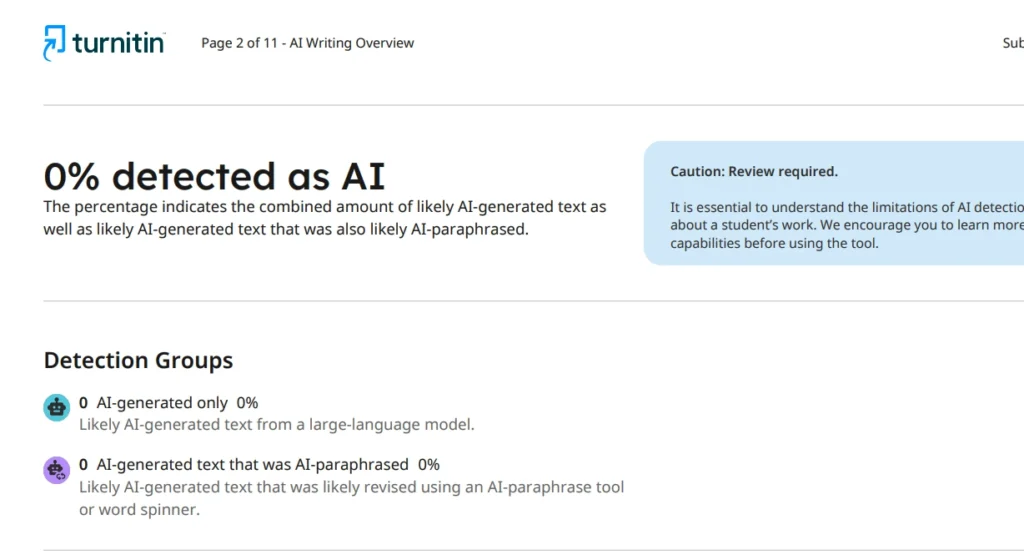
Turnitin report showing 0% AI

1–19% AI: Weak Signal (Hidden from View)

When Turnitin detects some AI-like patterns, but the estimated likelihood falls below 20%, the platform does not display a numerical score.

Instead, the report shows: *% detected as AI

This does not mean the paper is AI-generated.
It means the detected signal is too weak and too unreliable to present as a concrete percentage.
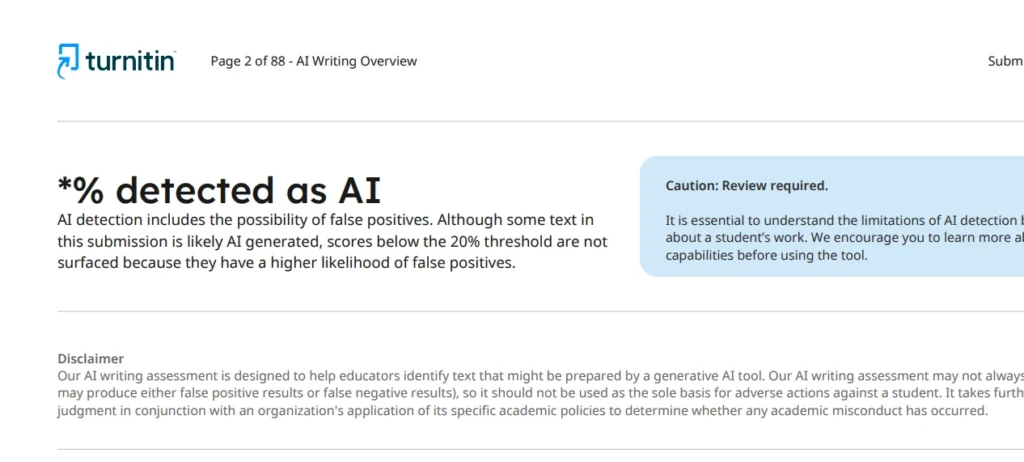
Turnitin report showing 0% AI
Turnitin report showing *%detected as AI

At this range, Turnitin considers the probability of false positives to be too high.

20% and Above: High-Confidence Detection

Once the AI likelihood reaches 20% or higher, Turnitin displays the percentage clearly.

At this level, the system has greater statistical confidence that AI-generated text is present.
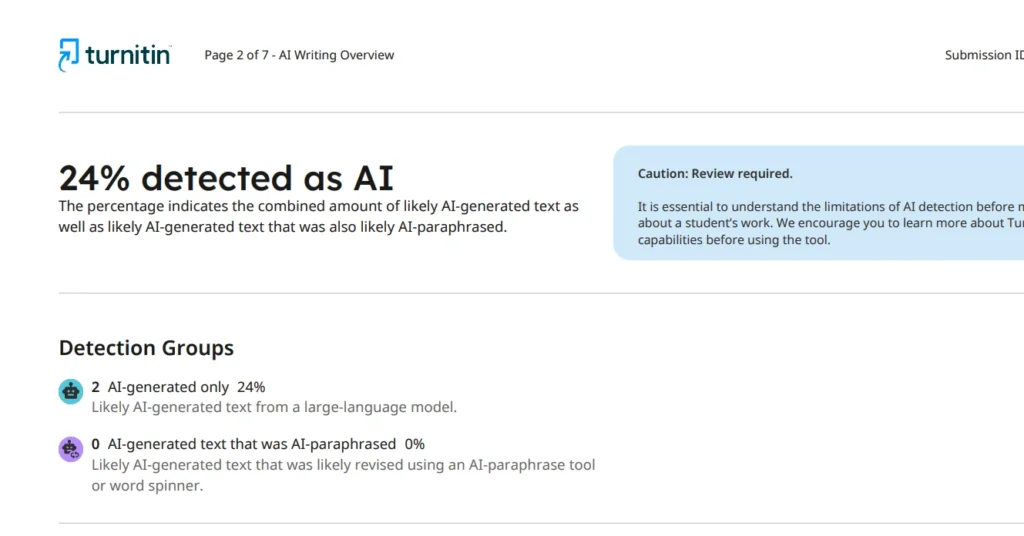
Turnitin report showing AI score above 20%

3. Understanding False Positives in AI Detection

The primary reason for the 20% threshold is the risk of false positives. A false positive occurs when the software flags human-written text as AI-generated.

Why Does Human Writing Look Like AI?

Several factors can cause a human-written document to trigger AI detection flags:

  • Highly Formal Academic Tone: Academic writing requires a level of precision and standardized phrasing that can mimic the “predictability” of AI.
  • Non-Native English Structures: Students writing in their second or third language may rely on standard grammatical templates or simpler sentence structures that AI models also favor.
  • Repetitive Phrasing: Technical papers or scientific reports often require the repetition of specific terminology, which can lower the “perplexity” of the text.
  • Strict Adherence to Templates: If a student follows a very rigid essay template provided by an instructor, the resulting structure may appear algorithmic.

Because these factors are common in high-quality academic work, a threshold is necessary to protect students who write clearly and formally.

Read more about Turnitin false positives here: False Positives in AI Detection: Why Human Writing Sometimes Gets Flagged as AI.

4. Breaking Down Turnitin’s Official Message

When a score is below 20%, Turnitin provides a disclaimer that acts as a safeguard for both students and educators. Let’s analyze the core of their official stance:
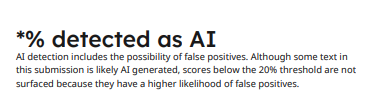
turnitin *% disclaimer

AI detection includes the possibility of false positives. Although some text in
this submission is likely AI generated, scores below the 20% threshold are not
surfaced because they have a higher likelihood of false positives.

“Possibility of False Positives”

This is a candid admission that the technology is not infallible. It reminds the user that the report is an indication, not a verdict.

“Likely AI Generated”

This phrase refers to the statistical probability. Even if the system “thinks” a paragraph is AI, it acknowledges that “likely” is not “certainly.”

“Higher Likelihood of False Positives”

This is the mathematical justification for the 20% rule. Statistical modeling shows that as the percentage of detected AI decreases, the error rate increases. By cutting off the display at 20%, Turnitin ensures that when a report does show a score, the probability of it being an error is significantly lower.

5. Should You Worry About a Hidden AI Score?

In short: Usually, NO.

If your report does not show an AI score, or if you are aware that it fell into the “hidden” sub-20% category, it is rarely a cause for concern. In the context of a 2,000-word essay, 15% would represent only a few paragraphs. Such a small amount of “AI-like” text is often just the result of a student using standard introductory phrases, bibliographies, or technical descriptions.

The threshold is designed to focus attention on significant uses of AI. Educators are generally advised to look for high-confidence flags rather than chasing marginal percentages that are likely the result of a student’s formal writing style.

6. How Educators Are Expected to Use AI Scores

Turnitin is meant to be a decision-support tool, not an automated judge.

Best practices encourage instructors to:

  • Review where AI is flagged, not just how much
  • Compare with a student’s previous writing
  • Use AI scores as a starting point for discussion, not punishment

The 20% threshold helps prevent over-policing and encourages contextual evaluation.

7. Common Misconceptions About Turnitin AI Detection

To navigate academic integrity in 2025, we must debunk several myths:

MythReality
“A hidden score means I cheated but got away with it.”No. A hidden score usually means your writing style was formal enough to create a “false alarm.”
“Any AI detection equals misconduct.”AI tools are often used for grammar checking or brainstorming; detection does not automatically equal a breach of integrity.
“AI scores are 100% accurate.”No AI detector is 100% accurate. They are probability engines, not truth-detectors.
“0% AI means no tools were used.”Not necessarily. It means no generative AI patterns were detected. It doesn’t account for simple spell-checkers.

Final Thoughts: The 20% Threshold Is a Safeguard, Not a Warning

Turnitin’s decision to hide AI scores below 20% is a deliberate safeguard, not a flaw.

It reflects an understanding that:

  • AI detection is imperfect
  • Academic writing often resembles AI output
  • False accusations can cause serious harm

Seeing 0% AI or a hidden “ *% detected as AI result should generally be interpreted as a sign that the system lacks sufficient confidence to raise concern.

In an era where AI tools continue to evolve, responsible interpretation — not blind reliance on percentages — is what truly protects academic integrity.

FAQ Section

Why does Turnitin show 0% AI but hide other low scores?

Turnitin shows 0% when there is no detectable AI signal at all. It hides scores between 1% and 19% because at those levels, the software cannot distinguish between actual AI use and a human writer using a formal, “robotic” tone.

Does a hidden AI score mean Turnitin detected AI?

It means the system found “weak” patterns that resemble AI, but the confidence level is too low to be considered reliable. In most cases, these weak signals are just human writing that happens to be highly structured.

Can Turnitin falsely detect AI in human writing?

Yes. This is why the 20% threshold exists. Highly technical, non-native English, or extremely formal writing is most susceptible to being falsely flagged.

Is the 20% threshold fixed or adjustable?

As of now, the 20% threshold is a standard setting within Turnitin’s AI detection model to ensure a baseline of reliability across all institutional reports.

Should instructors penalize based on AI percentages?

Most academic policies state that AI scores should be the beginning of a conversation, not the end. A percentage alone is not proof of misconduct; it requires a manual review by the instructor.

Was this helpful?
👍 ...
|
👎 ...
|
Loading...

Similar Posts

Leave a Reply

Your email address will not be published. Required fields are marked *